
 Available in US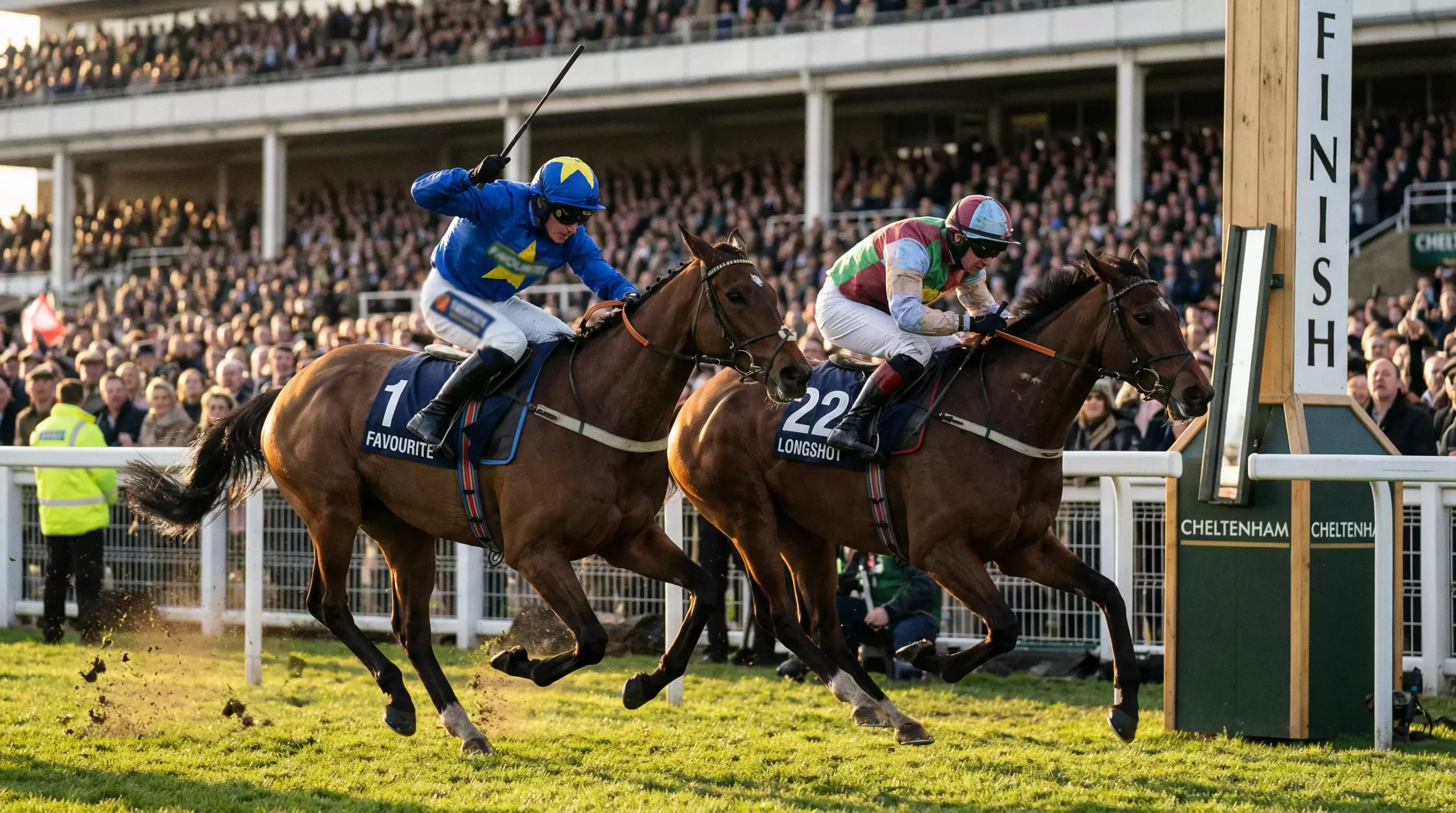
Why Favourites and Longshots Aren’t Priced Fairly
If the starting price were a perfect reflection of a horse’s chance, the long-run return on every price bracket would be identical — negative by the margin of the overround, but uniformly so. A £1 bet on an Evens shot would lose the same percentage over time as a £1 bet on a 33/1 outsider, once you adjusted for the bookmaker’s cut. That is the theory. The reality is nothing like it. Favourite-Longshot Bias in SP Betting — More on this topic at horse betting sp.
In practice, favourites consistently return more per pound staked than outsiders. This is the favourite-longshot bias, one of the most thoroughly documented phenomena in betting economics. Analysis of over 380,000 starts in Great Britain by FlatStats has quantified the gap: backing favourites at SP produces a loss of around 5% to 7%, while backing extreme outsiders at 33/1 and above produces losses exceeding 57%. Academic work, including a widely cited NBER study by Snowberg and Wolfers, confirms this pattern across multiple countries. The bias built into every price is not a conspiracy — it is a structural feature of how bookmakers construct their books and how the public distributes its money.
Understanding this bias will not hand you a winning system overnight. But ignoring it is the equivalent of playing poker without knowing the hand rankings. The numbers tell a story, and it is one that every SP bettor should be able to read.
The Evidence: ROI Across Price Brackets
The best publicly available breakdown of SP returns by price comes from FlatStats, which analysed UK turf racing across a multi-year dataset. The numbers are stark and consistent.
At SP Evens, horses win approximately 48% of their races — just below the 50% implied by the odds. The return on investment works out at −3.87%. That is the closest any price bracket gets to breaking even, and it means that a punter who backs every Evens shot at SP will lose roughly £3.87 for every £100 staked. Unpleasant, but survivable. A profitable selection method only needs to beat the market by four percentage points at this price range to turn a profit.
Move to SP 4/1, and the picture changes. Horses at this price win around 17.15% of the time against an implied probability of 20%. The ROI drops to −14.23%. The gap between what the price suggests and what actually happens has widened. You are now paying a materially larger tax for every bet.
At SP 33/1, the bias becomes brutal. The strike rate is just 1.24% — against an implied probability of around 3%. The ROI collapses to −57.67%. For every £100 wagered on 33/1 outsiders at SP, the expected return is barely £42. The market is not just slightly wrong about these horses; it is systematically overpricing them, and punters who chase big-priced runners at SP are subsidising the rest of the market.
The pattern is not unique to British racing. Academic studies have found favourite-longshot bias in virtually every horse racing jurisdiction where data is available, from the United States to Hong Kong. But the UK data is among the most detailed, thanks to the long history of SP recording and the depth of the FlatStats database. The bias is real, it is measurable, and it is remarkably persistent over time.
What drives it? There are several competing explanations. The simplest is that recreational punters overbet longshots because the potential payoff is exciting — a £2 bet at 33/1 returns £68, which feels transformational in a way that a £2 win at Evens does not. This demand pressure keeps longshot prices shorter than they should be, inflating the implied probability beyond what the horse’s actual chance justifies. Bookmakers, who are perfectly aware of this tendency, have no incentive to correct it. They profit from the mis-pricing.
A more nuanced explanation involves risk preferences. Some punters genuinely prefer long-odds bets even knowing the expected return is worse, in the same way that lottery players buy tickets despite astronomical odds. The utility of the potential windfall outweighs the mathematical disadvantage. In this view, the bias is not an error — it is a feature of how humans evaluate uncertain payoffs.
Is the Bias Shrinking? Post-2000 Trends
The favourite-longshot bias may be persistent, but it is not static. A study by Smith and Vaughan Williams, published in the International Journal of Forecasting, analysed ten seasons of UK Flat racing and found that the bias was significantly smaller in the period after 2000 compared with the years 1996–2000.
Several factors may explain the reduction. The rise of betting exchanges — Betfair launched in 2000 — introduced a new price-discovery mechanism that is structurally different from the traditional bookmaker market. On an exchange, prices are set by peer-to-peer supply and demand, and the overround is replaced by a flat commission. Exchange prices for longshots tend to be longer than bookmaker prices, reflecting the removal of the built-in bias. As exchange data became more visible to all market participants, it exerted a corrective pressure on bookmaker prices, nudging them closer to true probability.
The growth of professional punting syndicates, armed with sophisticated models and large bankrolls, has also contributed. These operators are not swayed by the emotional appeal of a 50/1 outsider. They bet where they identify value, and their activity pushes prices toward efficiency. When a 33/1 horse should really be 50/1, a syndicate will lay it on the exchange, driving the price out and narrowing the gap between implied and actual probability.
Online access to form data, race replays, and analytical tools has flattened the information asymmetry that once benefited insiders. The average punter in 2026 has access to more data than a professional handicapper had in 1996. That does not eliminate the bias — recreational betting patterns still skew the market — but it reduces the magnitude of the distortion.
The trend is encouraging for serious bettors. A shrinking bias means the market is getting harder to beat, but it also means the penalty for betting at longer prices is less severe than it once was. The question is whether the improvement will continue, or whether it has already plateaued.
What FLB Means for Your SP Bets
The practical implication of the favourite-longshot bias is straightforward: the longer the price, the worse the deal at SP. This is not a recommendation to only bet favourites — that is a separate question that depends on selection skill. It is a statement about the cost of betting.
Think of it as a sliding scale of taxation. At the short end, you are paying around 4% tax on every bet. At the long end, you are paying close to 58%. If your selection method is equally skilled across all price ranges — identifying value at the same rate regardless of odds — then you will generate more profit by concentrating on the shorter end, because the market’s drag is lower there. Your edge does not have to be as large to produce a positive return.
This has direct consequences for how you evaluate your betting record. If you are backing mostly 10/1 and 20/1 shots at SP and breaking even, you are actually performing extremely well — better, in real terms, than someone who is breaking even on favourites. The bias means that equivalent skill produces different financial outcomes depending on price range, and you need to adjust your expectations accordingly.
It also explains why certain types of bet — each-way outsiders, long-priced accumulators, speculative multiples — are structurally disadvantaged at SP. Each leg at a longer price amplifies the bias, and the cumulative effect across three or four selections is devastating. The bookmaker does not need to be wrong about any individual horse; the overround at each price point compounds into a virtually insurmountable edge.
Practical Adjustments for Bias-Aware Bettors
Knowing about the bias is step one. Adjusting your behaviour is step two, and it does not require a degree in statistics.
If you bet on longer-priced runners, consider taking a fixed price rather than SP. The early market sometimes offers prices that are longer than the eventual SP, which means you capture some of the value that the bias would otherwise erode. Combined with Best Odds Guaranteed, this approach gives you the longer price as a floor with the SP as a ceiling — a partial hedge against the bias.
If you are evaluating a tipping service or your own record, always assess ROI by price range rather than in aggregate. A service that claims +5% ROI overall might be achieving +20% on favourites and −30% on longshots, with the balance tipping positive only because it bets more at the short end. The aggregate number hides the structural reality.
Be honest about why you back long-priced runners. If the reason is “the potential payout is exciting,” you are paying the bias premium for entertainment, which is a perfectly legitimate choice — but you should not mistake it for a strategy. If the reason is a genuine belief that the horse’s chance is underestimated by the market, then the bias data gives you a benchmark: you need to be right by a much larger margin to overcome the structural disadvantage at longer prices. See also Rule 4 Deductions and Starting Price.
Finally, consider the exchange. Betfair’s SP typically runs closer to true probability than bookmaker SP, particularly at longer prices, because the overround on the exchange is lower. If you consistently bet at 10/1 and above, the saving on commission versus overround can be material over a season. The bias built into every price is not something you can eliminate. But knowing its shape — mild at the short end, savage at the long end — gives you the information to decide where to place your money and which battles are worth fighting.
