
 Available in US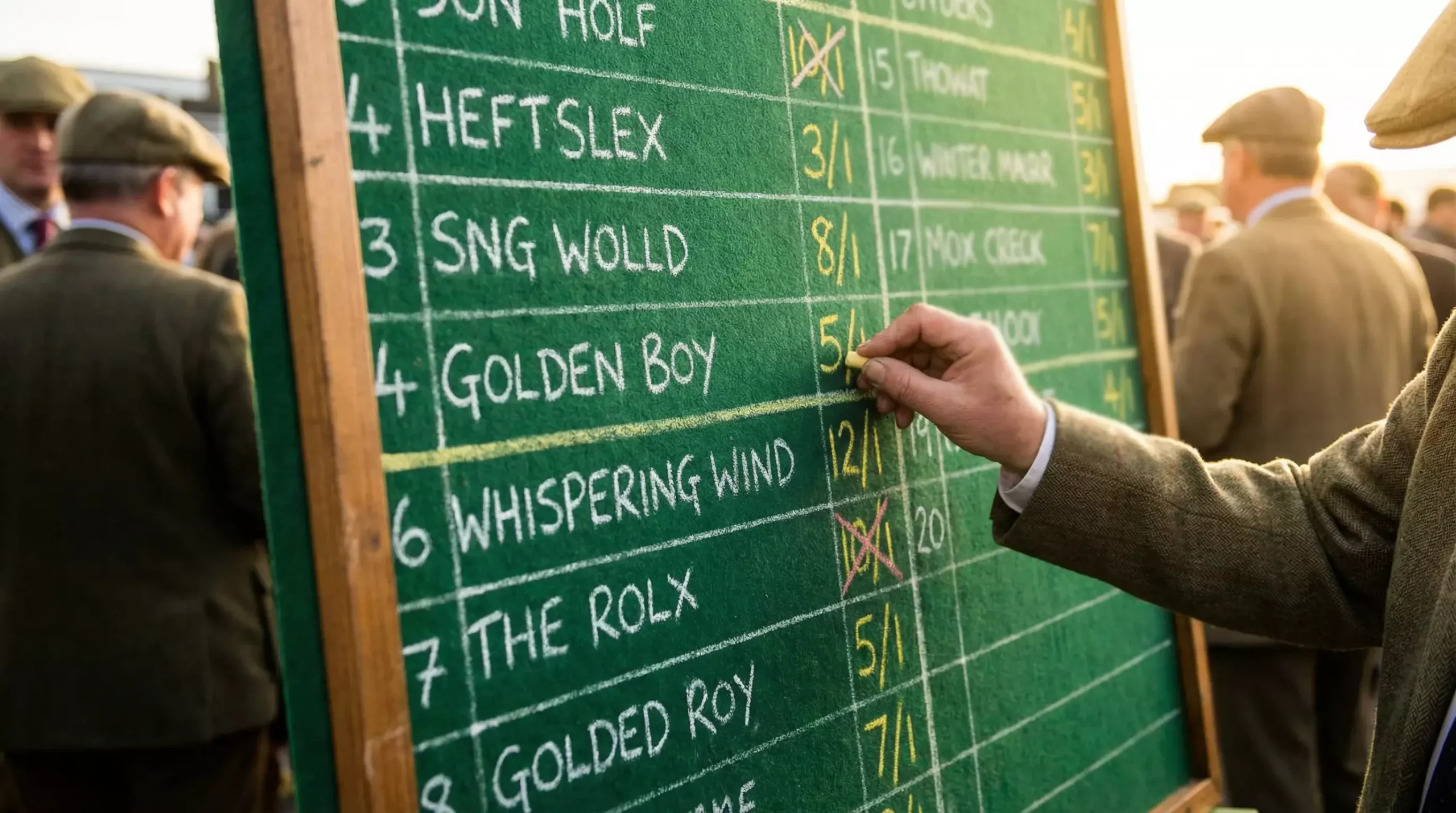
The Price Is Moving — What Does It Mean?
Watch any horse racing market in the thirty minutes before the off and you will see prices shifting — sometimes gently, sometimes violently. A horse that opened at 8/1 in the morning is now 4/1. Another that was 5/1 at lunchtime has drifted out to 12/1. These movements are not random. They are the visible footprint of money entering and leaving the market, and they carry information that shapes the SP every runner will eventually receive. SP Drifters and Steamers — More on this topic at horse betting sp.
The terminology is simple. A steamer is a horse whose price shortens significantly — money is pouring in, demand is high, and bookmakers cut the odds to manage their liability. A drifter is the opposite — a horse whose price lengthens because support has evaporated or money is actively being placed against it. Both movements tell a story, but not always the one punters assume.
The stakes are not trivial. According to SPRC consultation data, roughly 90% of all money wagered on a race is concentrated on the first three in the market. When the top of the market moves, the entire pricing structure shifts. Follow the money — but know when to stop — because not every move is what it appears to be.
Steamers: When Money Pours In
A steamer is the market’s way of saying: somebody wants this horse. The question is who, and why.
The most valuable steamers are driven by informed money — stable connections, professional syndicates, or punters with access to private trials and gallop reports. When a horse shortens from 10/1 to 5/1 in the space of an hour, with the move led by large stakes placed through accounts known to bookmakers as “sharp,” the signal is strong. The people closest to the horse believe it has a better chance than the morning price suggested.
Not all steamers carry equal weight. A price contraction driven by a single high-profile tipster going live on social media at 12:30pm is a different animal from a quiet, steady shortening that begins at 10am with no obvious public catalyst. The former is reactive — the public piling in because someone told them to — and the eventual SP often settles at a price that no longer represents value, because the move has been fuelled by volume rather than insight. The latter is proactive — the move is the information — and these are the steamers that serious market-watchers prize.
Timing also matters. A steamer that begins in the morning and sustains through to the off is a stronger signal than a late burst of activity in the final five minutes. Late money can be speculative, emotional, or even manipulative. Sustained movement over hours requires persistent demand from backers willing to accept progressively shorter prices, which implies a level of conviction that casual punters rarely sustain.
For SP bettors, a steamer poses a dilemma. If you wait for SP, you receive the end-point of the move — the shortest price the horse will trade at. If you backed the horse at a fixed price before the steam began, you captured value that no longer exists. Steamers reward early action and punish late arrivals.
Drifters: When Confidence Evaporates
A drifter is a horse whose price moves outward — from shorter to longer — as money dries up or is redirected elsewhere. It is the market withdrawing its support, and it can happen for any number of reasons: negative paddock reports, a jockey change, ground conditions shifting unfavourably, or simply a lack of interest from the big-money accounts.
Drifters carry a mixed reputation. The conventional wisdom is that a drifting horse is a losing horse — that the market knows something the form book does not. There is some truth to this at the extremes: a horse that drifts from 3/1 to 10/1 in the final twenty minutes is almost certainly sending a warning. Either the connections have lost confidence, or sharp money has identified a problem invisible to the public.
But moderate drift is not always negative. Academic research from the University of Leeds, analysing Yorkshire racecourses across 2013–2014 through the Shin measure of insider trading, found that the level of informed activity in SP markets was only slightly lower than in comparable markets — suggesting that while insiders do operate, the market is not overwhelmingly driven by private information. A horse that drifts from 5/1 to 7/1 might simply be the victim of a more fancied rival attracting late support. The horse’s actual chance may be unchanged; the market has just repriced around a competing signal.
For SP bettors, drift is a double-edged sword. On one hand, a drifting horse pays more at SP than it would have at an earlier fixed price — a mathematical bonus. On the other hand, if the drift reflects genuinely negative information, the longer price simply compensates for a reduced chance of winning. The return is better, but the probability is worse. Distinguishing between these two scenarios is the central skill of reading drifters.
Reading the Signal vs the Noise
Not every price movement contains useful information. The market is a noisy environment, and several factors can cause moves that look meaningful but are not.
Tipster-driven volatility is the most common source of noise. A popular tipster with 200,000 social-media followers posts a selection, and the price shortens by three points in ten minutes. The move looks like a steamer, but it is driven by a herd response rather than new information. Once the initial wave of bets is absorbed, the price often stabilises or even drifts back. These moves are not signals — they are echoes.
Bookmaker positioning can also create false moves. If a bookmaker needs to balance their book on a particular race, they may shorten a price to discourage further bets on that horse and lengthen another to attract money elsewhere. The resulting price shifts reflect the firm’s liability management, not a change in the horse’s chance. These are structural moves, not informational ones.
Genuine signals tend to share certain characteristics. They are sustained over a period of hours, not minutes. They occur without an obvious public catalyst. They are supported by volume — the total amount wagered, not just the direction of the price. And they often begin in the exchange market, where anonymity and liquidity attract the sharpest money, before filtering through to bookmaker prices.
The practical filter is simple: ask why. If you can identify a public reason for the move — a tipster, a media mention, a trending horse on social media — it is probably noise. If the move has no obvious explanation and the money appears to be coming from sources that do not normally advertise their positions, it is more likely to be signal.
Using Market Movement With SP Bets
If you bet at SP, you receive the final price after all the steaming and drifting has concluded. You cannot time the market. But you can use market movement as a filter — not for when to bet, but for what to bet on.
A horse that steams strongly and sustains that move into the off has attracted informed money. Backing it at SP means you receive the shortest price of the day, but you are aligning with the weight of the market. Over time, steamers at SP produce a better strike rate than drifters, which partly offsets the shorter price.
A horse that drifts without obvious cause presents a different opportunity. If your own analysis supports the horse and the drift appears to be noise rather than signal, the SP will be longer than the morning price. You are getting paid more for the same horse, and if your analysis is right, the expected value has improved. See also Betfair Starting Price (BSP) Deep Dive.
The worst outcome is chasing a steamer at SP without understanding why it shortened. You receive the compressed price, you have no edge over the market, and the overround ensures you are paying a premium for a horse that is now fully priced. Follow the money, absolutely — but know when the money has already arrived, and the value has left with it.
