
 Available in US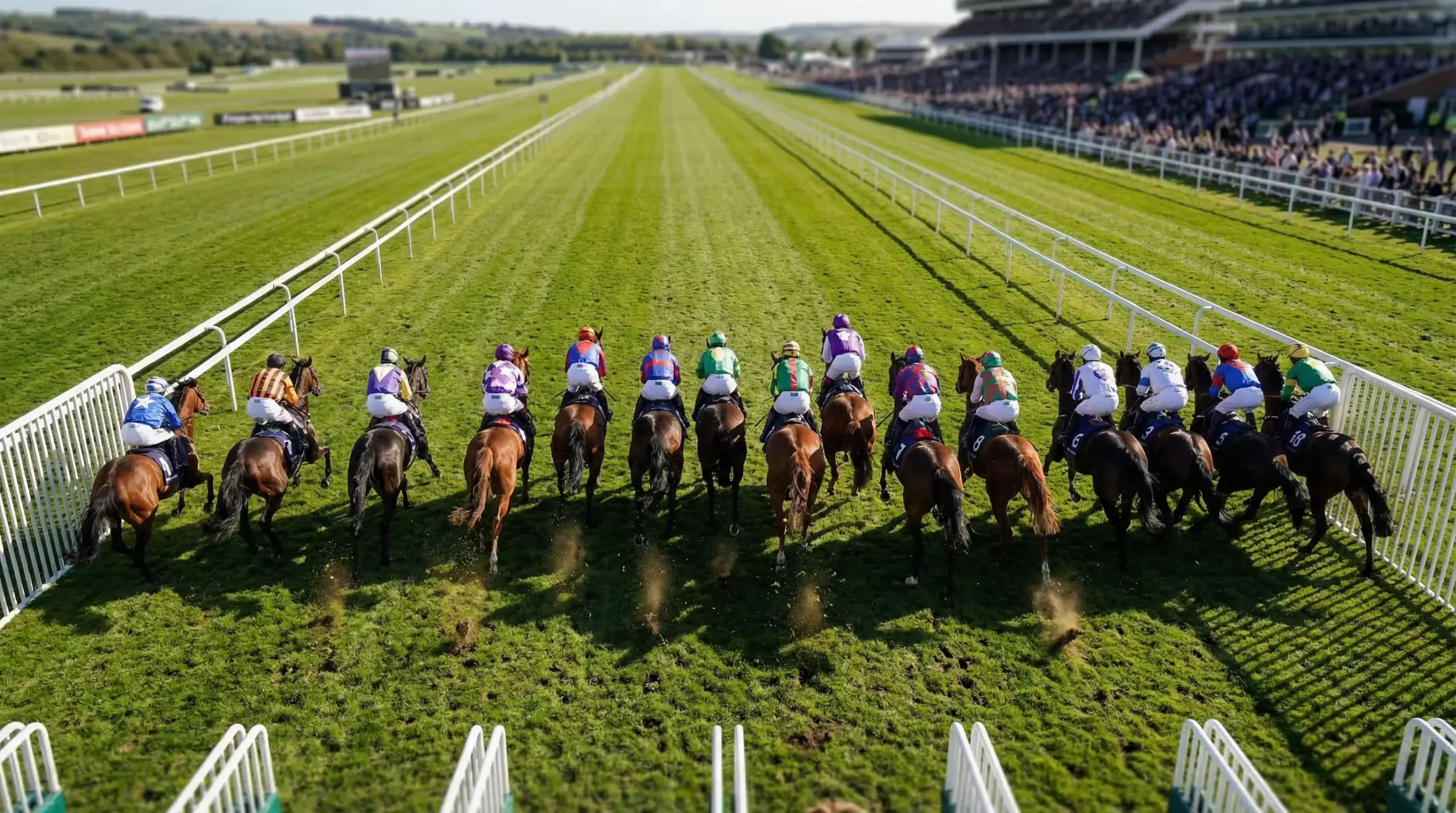
Why Field Size Is the First Thing to Check
Before you look at form, before you check the going, before you read a single tipster’s column — check the field size. The number of runners in a race is the single most important structural factor in determining the quality and value of the SP you will receive. It affects the total overround, the overround per horse, the distribution of prices across the market, and the liquidity from which the SP is drawn. SP and Field Size — More on this topic at horse betting sp.
The UK racing population includes approximately 18,452 active racehorses as of the BHA’s 2024 report, spread across thousands of fixtures each year. The field sizes produced by that population range from three or four runners in a weak maiden to thirty-nine in the Grand National. The SP behaves differently at each end of that spectrum, and the punter who treats a four-runner race and a twenty-runner handicap as equivalent markets is making a fundamental error. More runners, different maths — and the maths matters for your bottom line.
Overround Per Horse and Field Size
Total overround — the sum of all implied probabilities in a race minus 100% — rises mechanically with field size. A five-runner race might have a total overround of 115%, while a twenty-runner handicap could reach 140% or more. But comparing these numbers directly is misleading, because the twenty-runner race distributes its overround across four times as many runners.
Overround per horse, or OPH, normalises this by dividing the total overround by the number of runners. A five-runner race with 115% total overround has an OPH of 3.0%. A twenty-runner race with 140% total has an OPH of 2.0%. Despite the higher absolute overround, the twenty-runner race actually charges less margin per runner — which means each individual SP in that race is, on average, closer to the “true” price.
The relationship is not perfectly linear. Very large fields can produce anomalous OPH figures because pricing the back end of the market — the 50/1 and 100/1 outsiders — involves substantial guesswork by bookmakers. The SPRC’s consultation data noted that the 2015 Grand National, with 39 runners, had an OPH of 1.67% — slightly below the three-year average of 1.7%. At that scale, the overround per runner was actually tighter than in many smaller races, because the enormous betting volume on the National compressed the margins through competitive pressure.
For practical purposes, the message is that large-field races at major meetings tend to offer the tightest OPH, while small-field races at minor fixtures tend to produce the widest. The total overround number, taken in isolation, is deceptive. OPH tells you how much you are actually paying per runner.
Small Fields: Tighter Books, Closer Prices
In races with four to six runners, the SP landscape has distinctive characteristics. Prices are tightly clustered because there are only a handful of runners to price. The favourite is often odds-on or close to Evens, and the longest-priced runner may be only 8/1 or 10/1. The spread of the book is narrow.
This concentration has consequences. According to SPRC data, around 90% of all money wagered on a race is concentrated on the top three runners in the market. In a small field, the top three are the field — or close to it. This means that virtually all the money shaping the SP is focused on a small number of runners, producing prices that are well-supported by volume but offer limited scope for mispricings.
The advantage for SP bettors in small fields is that the prices tend to be efficient. The market has abundant form data on each runner, the betting volume is concentrated rather than dispersed, and the overround — while higher per horse — is distributed across a field where every runner is closely scrutinised. The disadvantage is that efficient prices leave less room for value. If the market gets a four-runner race roughly right, there is no angle for the SP bettor to exploit.
Small-field races are also where Best Odds Guaranteed is most valuable relative to SP. Because the prices are tight and the market is stable, taking an early fixed price and relying on BOG to capture any SP improvement is a low-risk strategy. The price is unlikely to move dramatically, and the BOG safety net costs nothing.
Large Fields: Where Longshots Get Squeezed
In races with sixteen or more runners — primarily handicaps — the dynamics shift. The market must price a wide range of abilities, from the 3/1 favourite to the 66/1 outsider. The spread of the book is enormous, and the overround is distributed unevenly across that spread.
The favourite-longshot bias is amplified in large fields. At the short end, the favourite’s price is set with confidence — high volume, deep form, and competitive pressure keep it relatively fair. At the long end, outsiders are priced with much less certainty. Bookmakers build in extra margin on runners they know little about, and the cumulative effect is that the SP on a 33/1 or 50/1 outsider in a large field includes a disproportionate share of the total overround.
This creates a paradox for each-way bettors. Large-field handicaps offer the most generous place terms — four places at 1/4 the odds in fields of sixteen or more — but the overround on the place fraction is derived from an already-inflated SP on longer-priced runners. The place return looks attractive in isolation, but the margin embedded in the underlying price erodes its value.
Where large-field races do offer opportunity is in the middle of the market — runners priced between 6/1 and 14/1 that are well-handicapped but unfashionable. These horses attract moderate volume, their prices are set with reasonable accuracy but not surgical precision, and the overround at this range is less punitive than at the extremes. If you have genuine form insight into a large-field handicap, the SP in this band can offer value that simply does not exist in a four-runner conditions race.
Using Field Size in Your SP Betting Decisions
Field size should inform every aspect of your SP decision-making.
In small fields, trust the market. The SP is likely to be efficient, the overround per horse is manageable, and the risk of a distorted price is low. Use BOG where available to capture any marginal improvement. Your edge in small fields comes from selection — picking the right horse — not from pricing.
In large fields, question the market. The SP is less efficient at the extremes, the overround distribution is uneven, and the pricing of outsiders involves significant guesswork. If you have specialist knowledge — track bias, handicap analysis, trainer patterns at specific courses — the SP in a large-field handicap may underestimate your selection’s chance. This is where form study pays its greatest dividend relative to the market. See also How On-Course Bookmakers Shape the Starting Price.
Pay attention to the middle ground. Races with eight to twelve runners occupy a space where the market is reasonably efficient but not ruthlessly so. These are the races where careful analysis can identify value at SP without the noise and overround distortion of a thirty-runner cavalry charge. Field size is not the answer to every SP question — but it is the first question worth asking.
