
 Available in US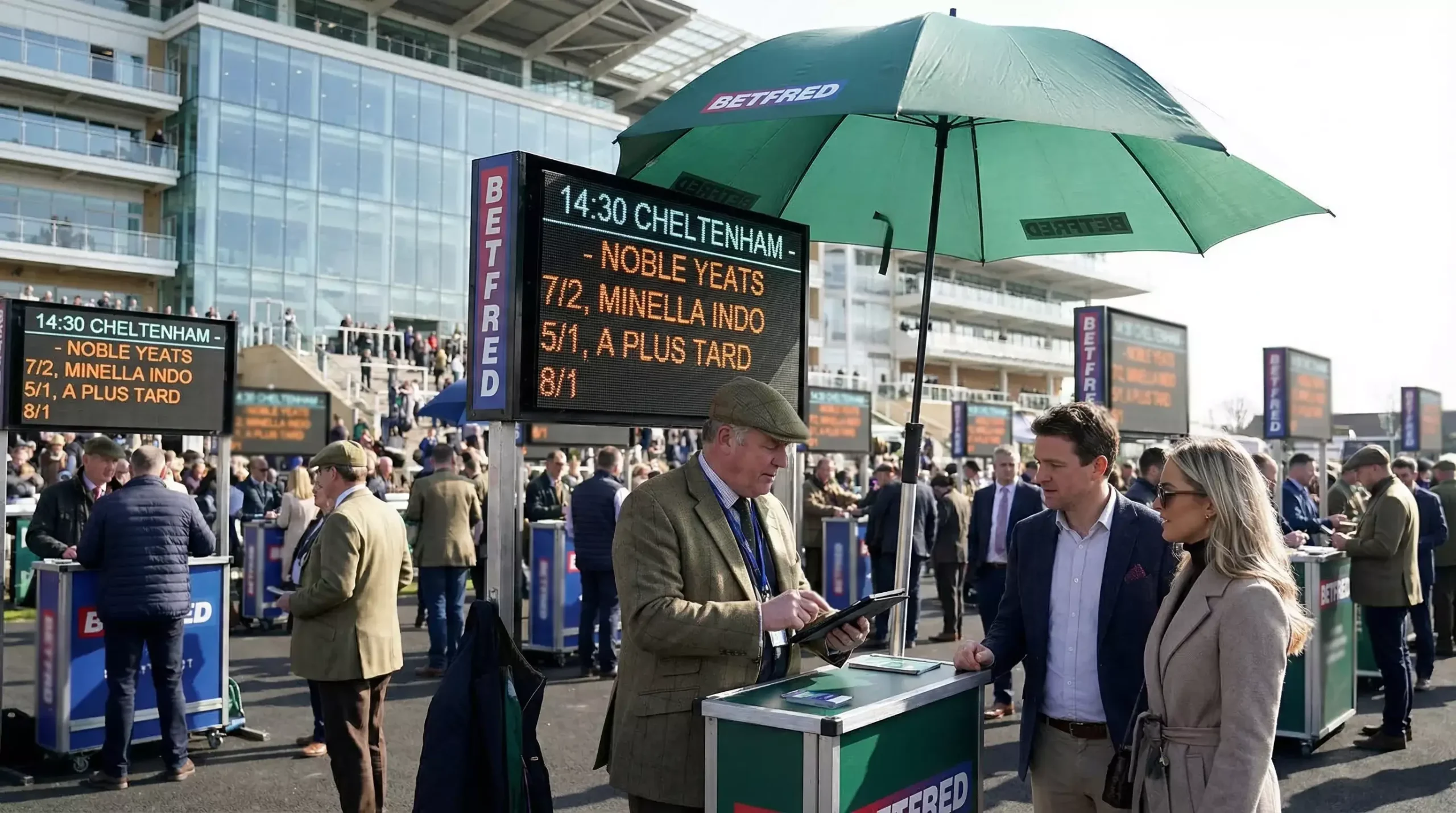
The Betting Ring — SP’s Original Home
Long before the first betting website loaded, the starting price was born in the betting ring. On-course bookmakers — standing at their pitches, chalking prices on boards, taking bets from racegoers face to face — were the original market-makers. The prices they displayed formed the sample from which the SP was calculated, and for over a century their boards were the definitive expression of where the market stood at the off. How On-Course Bookmakers Shape the Starting Price — More on this topic at horse betting sp.
The ring is not dead. With racecourse attendance reaching 5.031 million in 2025 — back above five million for the first time since 2019 — the physical betting ring continues to operate at every British meeting. But its role in SP formation has changed fundamentally, and understanding that change is essential for anyone who wants to know what their starting price actually represents.
How On-Course Boards Work
An on-course bookmaker operates from an allocated pitch on the racecourse betting ring. The pitch — a physical position within the ring — is assigned by the racecourse and can be a valuable asset, with prime positions near the main entrance commanding premiums. Each bookmaker displays their prices on a board, either a traditional chalk board or, increasingly, an electronic display.
The prices on these boards are live offers. A punter who approaches a board showing 5/1 on a particular horse can bet at that price, and the bookmaker is obliged to honour it (subject to stake limits). The bookmaker adjusts prices in response to the bets they take: heavy money on one horse causes its price to shorten, while a lack of interest on another causes it to drift. This real-time adjustment is the essence of price discovery — the market converging on a consensus through the aggregate weight of money.
The SP sample is drawn from these board prices. According to the SPRC’s consultation document, the maximum sample size is 24 bookmakers, and the minimum is six — though on all-weather meetings the minimum drops to as few as three. The sampled prices are ranked, and the median is taken as the SP. This median approach filters out outliers: a single bookmaker offering a wildly different price from the rest does not distort the final figure.
The quality of the sample depends directly on the number and competitiveness of bookmakers present. At a well-attended Saturday meeting at York or Newmarket, twenty or more bookmakers may be trading, producing a deep, diverse sample. At a Monday card at Plumpton, six bookmakers might constitute the entire ring, and the sample is correspondingly thin.
From Ring to SP: The Sampling Process
The process of recording on-course prices for the SP sample involves designated representatives who capture the board prices at the moment the race starts. These representatives — historically associated with the Sporting Life and the Racing Post, now operating under the SPRC’s governance — note the prices displayed by each sampled bookmaker and transmit them for calculation.
The on-course sample was, for most of SP history, the only input. Off-course bookmakers — the high-street shops, the telephone betting services, and later the online platforms — settled bets at SP but did not contribute to its formation. The price was set by the ring and applied to the entire market.
This created an asymmetry that grew more pronounced as off-course betting eclipsed on-course wagering. By the time of the SPRC’s 2020/21 review, on-course betting accounted for just 1.4% of total wagering on British racing. The SP was being determined by a market that represented a tiny fraction of the money at stake. A price set by 1.4% of the market was settling 100% of the bets — a structural mismatch that COVID forced the industry to address.
The introduction of the Industry Starting Price incorporated off-course prices into the sample, fundamentally changing the relationship between the ring and the SP. On-course prices now contribute to the ISP where available, but they no longer drive it. The ring feeds data into a blended model, rather than being the sole source.
Post-COVID Reality: Fewer Bookmakers, Different Dynamics
The pandemic accelerated a decline in on-course bookmaker numbers that had been underway for years. Lockdown eliminated their income overnight, and not all returned when racing resumed. The economics of on-course bookmaking — travelling to meetings, paying pitch fees, staffing a position — had been marginal for many operators even before COVID. The enforced break pushed some into retirement.
Those who did return found a changed landscape. Crowds were back, but betting behaviour had shifted. Many racegoers who might previously have bet at the ring now placed their wagers on phones, even while standing on the course. The convenience of app betting, combined with promotions like Best Odds Guaranteed that are not available on-course, made the bookmaker’s board a harder sell.
The result is a ring that is smaller and less influential than at any point in its history. At major meetings — Cheltenham, Royal Ascot, the Grand National — the ring remains vibrant, with large crowds and competitive pricing. At everyday meetings, the ring can feel sparse, with a handful of bookmakers offering prices to a modest flow of customers. The sample from these thinner rings, while still contributing to the ISP, carries less statistical weight than it did when the ring was the sole source of SP data.
There is also a qualitative change. On-course bookmakers at well-attended meetings are exposed to information that off-course firms are not — the look of a horse in the paddock, the body language of connections, the murmur of the crowd after a parade-ring inspection. This “ring intelligence” was historically one of the on-course market’s strengths, producing a price informed by visual assessment as well as form data. As the ring shrinks, this informational advantage narrows, and the SP becomes more dependent on the algorithmic pricing of online firms.
Why On-Course Bookmakers Still Matter
Despite their diminished role in SP formation, on-course bookmakers contribute something that off-course data feeds cannot replicate: independent, human price-setting in real time.
An on-course bookmaker sets prices based on their own judgement, their own liability, and their own reading of the market. They are not running the same algorithm as every other firm. They are not adjusting prices in lockstep with a central trading desk. Each board is an independent expression of opinion, and the diversity of those opinions is what gives the on-course sample its statistical value. When twenty bookmakers are offering slightly different prices on the same horse, the median of those prices filters out individual error and converges on a market consensus.
Off-course bookmaker prices, by contrast, are often correlated — many firms use similar pricing models, react to the same data feeds, and adjust prices in similar patterns. The ISP sample includes these prices, but the independence of each data point is lower than in a ring full of bookmakers making their own calls.
For the punter, the on-course ring also offers a direct betting experience that carries advantages the app cannot match. On-course bookmakers sometimes offer prices that are a tick better than online, particularly for large stakes where the bookmaker prefers to take the bet on-course rather than manage it through online liability systems. There is no BOG on-course, but there is negotiation — a punter placing a substantial bet can sometimes secure a better price through direct conversation. See also SP for Occasional Bettors.
The boards that still set the price — or at least contribute to it — represent the last surviving link between the Victorian origins of the SP and its modern incarnation. Whether that link endures depends on whether the economics of on-course bookmaking can sustain a viable number of operators, and whether the racing public continues to value the ring as part of the racecourse experience. For now, the boards stand. How long they shape the price is a question the next decade will answer.
