
 Available in US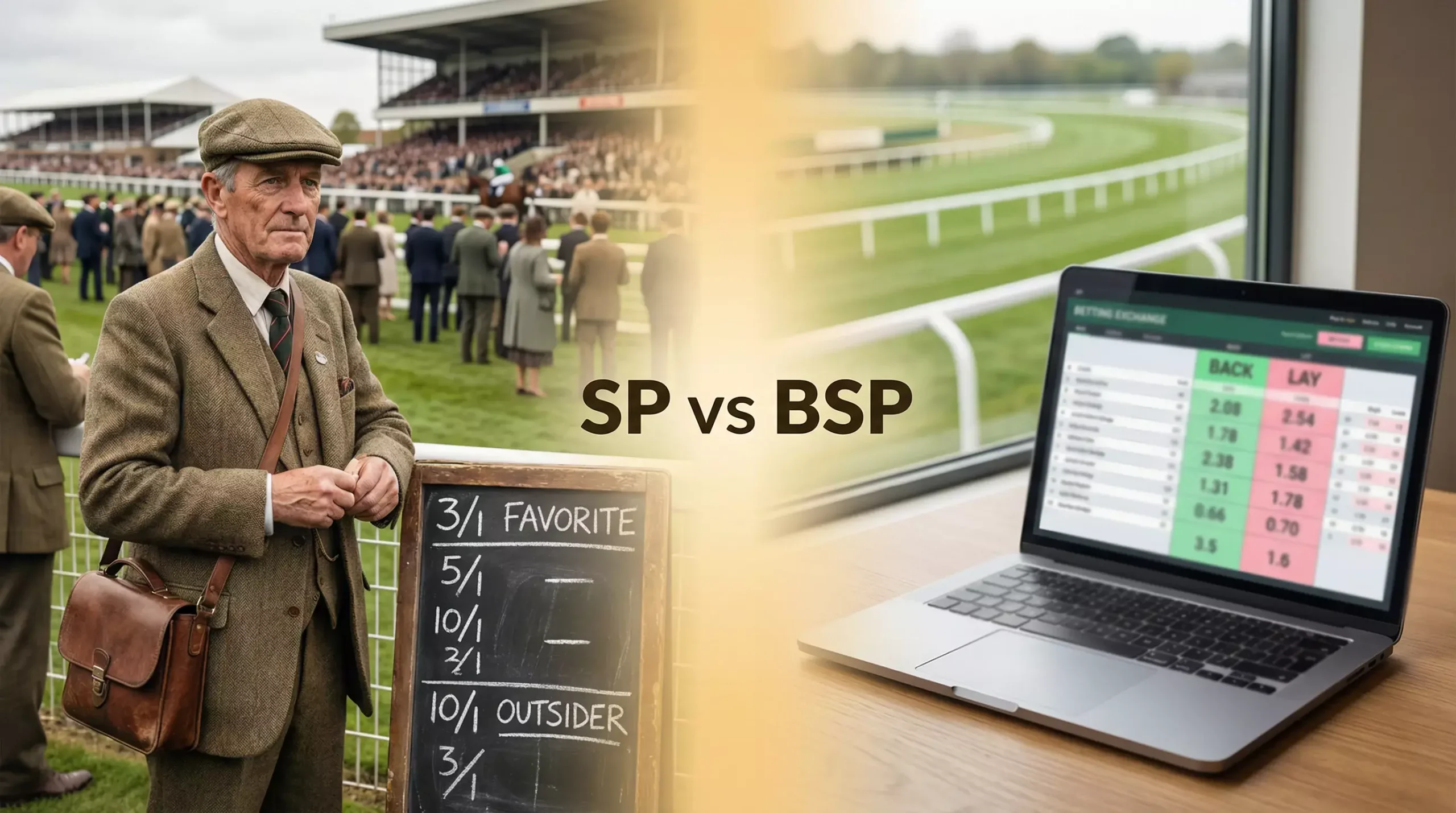
Two Starting Prices, One Race — Different Returns
British horse racing has a peculiar distinction: it offers punters not one but two versions of the starting price. The traditional SP, set by the Starting Price Regulatory Commission through its Industry Starting Price model, is the price that settles the vast majority of bets placed in shops and online without a fixed price. Then there is the Betfair Starting Price — BSP — calculated entirely within the Betfair Exchange, where punters bet against each other rather than against a bookmaker. Both numbers appear after the same race, for the same horse, at the same moment. Yet they are often different, sometimes substantially so. SP vs BSP — More on this topic at horse betting sp.
The difference is not random noise. It reflects a structural gap in how the two prices are formed, and that gap has a measurable impact on long-term returns. Modelling by On Course Profits using UK and Irish racing data estimates that the traditional SP carries an average overround of approximately 130%, meaning the implied probabilities of all runners in a race sum to 130% of certainty. BSP, by contrast, operates close to 100% — near-zero overround. That 30-percentage-point gap is not a rounding error. It is the difference between betting into a market that extracts a systematic margin and betting into one that, at least in theory, does not.
The overround tells the story, and this article follows where it leads. But overround alone does not settle the argument. BSP has its own costs, its own limitations, and its own scenarios where it delivers less than the traditional SP. A data-driven comparison needs to account for all of it — the commission Betfair charges, the liquidity constraints that affect outsiders, and the practical realities that mean the theoretical advantage of a near-zero overround does not always translate into a real-world edge.
How BSP Works on Betfair Exchange
To understand why BSP behaves differently from SP, you need to understand how the Betfair Exchange operates — and how BSP emerges from that mechanism rather than being imposed on it.
On a traditional betting exchange, punters place bets at specific odds. You can back a horse (bet on it to win) or lay it (bet against it), and your bet is matched with someone on the other side. Prices are set by supply and demand: if more people want to back a horse than lay it at a given price, the price shortens until equilibrium is found. There is no bookmaker in the conventional sense; Betfair simply provides the marketplace and takes a commission on net winnings.
BSP sits on top of this system as a special order type. Instead of requesting a specific price, a punter can choose to accept whatever the BSP turns out to be. The BSP is calculated at the moment the race starts, using an algorithm that processes all unmatched back and lay orders in the exchange market. It finds the price at which the maximum volume of bets can be matched, accounting for the money waiting on both sides. Think of it as a clearing price — the point where supply and demand intersect.
The scale of data behind this mechanism is considerable. According to Betfair’s own documentation, BSP has been calculated across more than 381,000 races with over 3.2 million individual runner starts. Across that dataset, implied probabilities derived from BSP align closely with actual outcomes — a hallmark of a well-functioning market. When the BSP implies a horse has a 25% chance of winning, horses at that price really do win approximately 25% of the time.
There are protective rails built into the system. Punters placing BSP orders can set a minimum acceptable price (for backers) or a maximum acceptable price (for layers). If the calculated BSP falls outside those limits, the order is returned unmatched. This prevents a situation where a sudden wave of money in one direction produces a BSP so extreme that participants are caught out. Betfair also has mechanisms to handle thin markets: if there is insufficient liquidity on one side of the book, the BSP algorithm adjusts to reflect the available data rather than producing a distorted price.
The critical structural difference is this: the traditional SP is derived from the prices bookmakers choose to offer, and those prices include a margin that protects the bookmaker’s position. BSP is derived from the prices punters choose to trade at, and the only margin extracted is Betfair’s commission on winning bets. The bookmaker’s built-in edge is replaced by a marketplace fee. That substitution is what drives the overround gap — and it is what makes the comparison worth examining in detail.
Overround Face-Off: 30% vs Near-Zero
The single most important number in the SP-versus-BSP comparison is the overround, and the gap between the two is not subtle. Traditional SP markets in UK horse racing carry an average overround of approximately 130%, according to the On Course Profits model — meaning that for every £1.00 of true probability in a race, SP bettors are collectively paying around £1.30. Betfair’s BSP, by contrast, hovers close to 100%, with overrounds that are negligible or occasionally negative once the market clears. The difference is roughly 30 percentage points of margin, and it compounds relentlessly across every race, every day, every season.
To feel what that means in practice, imagine two punters betting identically — same selections, same stakes, same races, same year. One takes SP with a traditional bookmaker; the other takes BSP on Betfair. Ignoring commission for a moment, the BSP bettor is consistently getting longer odds on the same horses. Not dramatically longer on any single runner, necessarily, but systematically longer. Over a hundred bets, the cumulative effect is unmistakable. Over a thousand, it reshapes the entire profit-and-loss picture.
The overround does not, however, distribute evenly across the field. This is a nuance that raw overround figures obscure. In a typical SP book, shorter-priced runners carry a relatively modest overround per horse, while outsiders bear a disproportionate share of the margin. A favourite at 2/1 might be priced at roughly 2% above its true probability; a 25/1 outsider in the same race might be priced at 8% or more above fair value. This skew is a feature of bookmaker risk management: they price competitively where the money is (the favourites) and pad margins where the money is not (the outsiders). BSP flattens this curve. Because exchange pricing is driven by bettors on both sides rather than by a single bookmaker’s risk model, the overround at each price point tends to be smaller and more uniform. The result is that BSP’s advantage over SP grows as you move further down the market. A punter who specialises in outsiders at 10/1 and above sees a much larger BSP benefit than one who backs nothing but odds-on favourites.
There is an elegant way to visualise this. Plot the SP of every runner in a dataset on the x-axis and the corresponding BSP on the y-axis. If SP and BSP were identical, every point would sit on a 45-degree line. In practice, the points form a curve that bows above the line, and the bow becomes more pronounced at longer prices. At 2/1, the BSP might be 2.1 or 2.2. At 20/1, the BSP might be 24 or 25. At 50/1, the divergence can be 60/1 or beyond. The relationship is not linear; it is roughly quadratic, and the curvature is driven entirely by the way traditional bookmakers load overround onto outsiders.
None of this means BSP is a magic formula. The overround advantage is real and large, but it exists before commission is applied. Once Betfair takes its cut — between 2% and 9% of net winnings depending on the chosen rewards package — the net advantage narrows. And in races with thin exchange liquidity, the BSP itself can be unreliable, sometimes coming in shorter than the SP rather than longer. The overround face-off is decisive in aggregate, but the details of commission and liquidity determine whether that aggregate advantage translates into a practical edge on any given day.
Price Divergence Across Odds Ranges
The overround gap sets the framework. The price divergence across specific odds ranges fills in the detail, and it is here that the favourite-longshot bias makes its presence felt in the SP-versus-BSP comparison.
Long-term data compiled by FlatStats breaks down SP returns by price bracket, and the pattern is stark. At SP Evens, the actual strike rate is 48% against an implied probability of 50%, producing a return on investment of approximately −3.87%. At 4/1, the strike rate drops to 17.15% against an implied 20%, delivering an ROI of −14.23%. At 33/1, winners come in at 1.24% against an implied 2.94%, and the ROI craters to −57.67%. The further you move from the top of the market, the worse the deal the SP offers — because the overround extracted from outsiders is vastly higher than the overround extracted from favourites.
BSP compresses this damage. Because exchange-derived prices carry little to no overround, the BSP at 33/1 is typically much longer than the SP at 33/1 for the same horse. In practical terms, a runner whose SP is 33/1 might return a BSP of 40/1 or 45/1. The bettor who took BSP gets paid significantly more for the same winner. Over a large sample, that price improvement at the longer end of the market is where the aggregate BSP advantage is generated. Punters who concentrate on favourites see a much smaller difference, because SP is already reasonably competitive at short prices.
This creates a natural segmentation. If your betting style leans towards favourites and short-priced selections — the kind of methodical, low-variance approach that many professional bettors adopt — the BSP advantage exists but is modest. After commission, you might gain a percentage point or two of ROI over SP. That matters across thousands of bets, but it is not transformative on any given Saturday. If, on the other hand, you bet into the mid-range (5/1 to 14/1) or beyond, BSP offers a structural uplift that can turn a marginal SP loss into a marginal BSP profit — or at least reduce the bleed rate significantly.
The implication for strategy is clear: the decision between SP and BSP should be influenced by your typical price range. Backing odds-on shots? SP and BSP are close enough that convenience, Best Odds Guaranteed, and other factors can reasonably tip the balance toward a traditional bookmaker. Backing outsiders in big-field handicaps? BSP is likely the better vehicle for every single bet, and the advantage compounds as the prices lengthen. The data does not whisper this conclusion; it states it plainly.
Liquidity, Minimums and Practical Limits of BSP
BSP’s theoretical advantage is persuasive. Its practical application comes with caveats that the overround comparison alone cannot capture. The most significant of these is liquidity — or, more precisely, the absence of it in certain markets.
Betfair’s exchange is a marketplace, and like any marketplace, it functions well when there are plenty of participants on both sides. For feature races at major meetings — the Saturday afternoon cards at Ascot, Cheltenham, Newmarket, York — exchange liquidity is deep. Tens of thousands of pounds are matched in the final minutes before the off, the BSP settles at a price derived from genuine competitive tension, and the result is a fair, reliable figure. For a Monday afternoon handicap at Catterick with eight runners and minimal public interest, the picture changes. Fewer punters engage with the exchange market, the money available for matching is thinner, and the BSP can settle at a price that is less reflective of true market consensus.
In thin markets, BSP can produce anomalies. A sudden unmatched lay order just before the off can push the BSP shorter than the SP, which reverses the expected relationship entirely. A large unmatched back order can push it wider, creating an apparent windfall that really reflects illiquidity rather than genuine value. These events are uncommon in feature races but not rare in the lower tiers of the programme — precisely the fixtures where outsiders and longshot specialists tend to hunt for value.
There are also structural minimums to consider. Betfair requires a minimum stake of £2 for BSP orders, and unmatched portions of BSP bets are handled according to the Near Price and Far Price mechanisms. The Near Price is the best available odds within a set range of the BSP; the Far Price is the worst. If your BSP order cannot be matched at the Near Price, it may be partially or fully returned. For large-stakes bettors, this means BSP can be unreliable for placing significant volume at outsider prices, because the exchange market may not have sufficient depth on the lay side to absorb the bet.
The practical consequence is that BSP is most dependable where it is least needed (short-priced runners in liquid markets, where the BSP advantage over SP is smallest) and least dependable where it is most valuable (outsiders in illiquid markets, where the theoretical uplift is greatest). This is not a reason to dismiss BSP, but it is a reason to approach it with a clear view of where the exchange market is thick enough to deliver on the promise of near-zero overround — and where it is not.
Commission and Its Effect on Net Returns
Every discussion of BSP advantages must eventually reckon with the exchange’s take. Betfair charges commission on net winnings — the default Rewards rate is currently 6%, though users who opt for the Basic package pay just 2%, and the Rewards+ tier is charged at 9%. That commission is the price of entry to a near-zero-overround market, and it narrows the gap between BSP and SP by a meaningful amount.
Consider a concrete scenario. A horse wins at a BSP of 5.0 (4/1 in fractional terms). A £10 back bet returns £50 gross — £40 profit plus the £10 stake. At 5% commission, Betfair deducts £2.00, leaving net winnings of £38.00. The same horse’s SP might have been 7/2, paying £45 gross — £35 profit, no commission. In this case, the BSP still comes out ahead by £3 in net terms. But the margin is thinner than the raw prices suggested, and it depends entirely on how far the BSP exceeded the SP. In races where the BSP is only marginally longer than the SP — common at shorter prices — the commission can erase the advantage entirely or even reverse it.
Commission also interacts with betting style. A punter who backs long-priced winners infrequently but at high odds will accumulate large gross wins and correspondingly large commission charges on those wins, while enjoying many losing bets on which no commission is paid. Over time, the net commission rate on their total turnover is lower than 5%, because it only applies to winning bets. A punter who backs favourites with a high strike rate pays commission more often, and the effective drag on returns is proportionally greater.
The industry context adds a layer to this calculation. As Grainne Hurst, CEO of the Betting and Gaming Council, noted when the Horserace Betting Levy reached record levels in 2024/25, regulated betting continues to increase its contribution to the sport even as the industry faces mounting commercial pressure. That pressure is not abstract: total betting turnover on British racing fell 6.8% in 2024 compared with 2023, and 16.5% compared with 2022. Those declining volumes are one reason traditional bookmakers maintain the margins they do. The overround baked into SP is not arbitrary; it funds the levy, covers operational costs and generates the profit that keeps licensed operators in business. BSP sidesteps much of that overhead, but the commission remains as the exchange’s own cost of operation.
The net effect: BSP after commission is still typically better value than SP at prices above roughly 3/1, and the advantage grows with price. Below 3/1, the picture is murkier, and factors like Best Odds Guaranteed, bookmaker bonuses and free-bet offers can tip the balance back towards traditional SP. The commission is a real cost, but it is a smaller cost than the overround it replaces.
When SP Beats BSP: Scenarios That Flip the Script
The aggregate data favours BSP. The aggregate data does not bet on individual races. There are specific, recurring scenarios where the traditional SP delivers a better outcome — and recognising them is as important as understanding the overround gap.
The most common scenario is Best Odds Guaranteed. Many traditional bookmakers offer BOG on UK and Irish racing, meaning that if you take a fixed price in the morning and the SP is higher, you are paid at the SP instead. If you take a fixed price and the SP is lower, you keep your original price. This effectively gives the punter a free option: the better of two prices. BSP has no equivalent mechanism. A punter who takes an early price with a BOG bookmaker captures the upside of any late drift toward a longer SP without bearing the downside of a shortening market. In races where prices move significantly between the morning and the off — which is a substantial minority of all races — BOG can deliver returns that exceed BSP.
The second scenario involves odds-on favourites and very short-priced runners. At these prices, the overround per horse in the SP book is small, often just 1–2%. After Betfair’s 5% commission on winnings, the net BSP can actually be shorter than the SP in effective terms. A horse that wins at BSP 1.50 delivers £5 profit on a £10 bet, minus £0.25 commission — net £4.75. If the SP was 4/9 (decimal 1.44), the SP payout is £4.44 profit with no deduction. BSP wins on paper; BSP wins in practice. But if the SP was 1/2 (decimal 1.50), the payout is £5.00 — and BSP after commission delivers less. The margins are razor-thin at these prices, and commission tips the balance more often than you might expect.
A third scenario is illiquid exchange markets, already discussed. When the BSP settles unreliably because the matching pool is thin, the SP — backed by a larger and more established pricing mechanism — can be the more trustworthy figure. This is most likely on all-weather cards, low-grade fixtures and races with very small fields, where the exchange simply does not attract enough participation to produce a competitive BSP.
Finally, there is the question of access and simplicity. SP is available everywhere: every bookmaker, every betting shop, every app. BSP requires a Betfair account, an understanding of exchange mechanics, and the willingness to accept a price that is not known until the race starts. For many recreational bettors, that is a hurdle they would rather not clear — and the convenience of SP, particularly with BOG attached, is a genuine advantage that no overround calculation can fully capture. See also SP Betting Strategy.
The verdict, then, is not binary. BSP is the structurally better deal for the majority of bets at the majority of prices, and the data supports that conclusion convincingly. But SP, armed with BOG and the backing of a simpler, more accessible infrastructure, wins often enough in specific situations to remain a rational choice — particularly for punters who bet at shorter prices and value the certainty of knowing their price before the off.
