 Available in US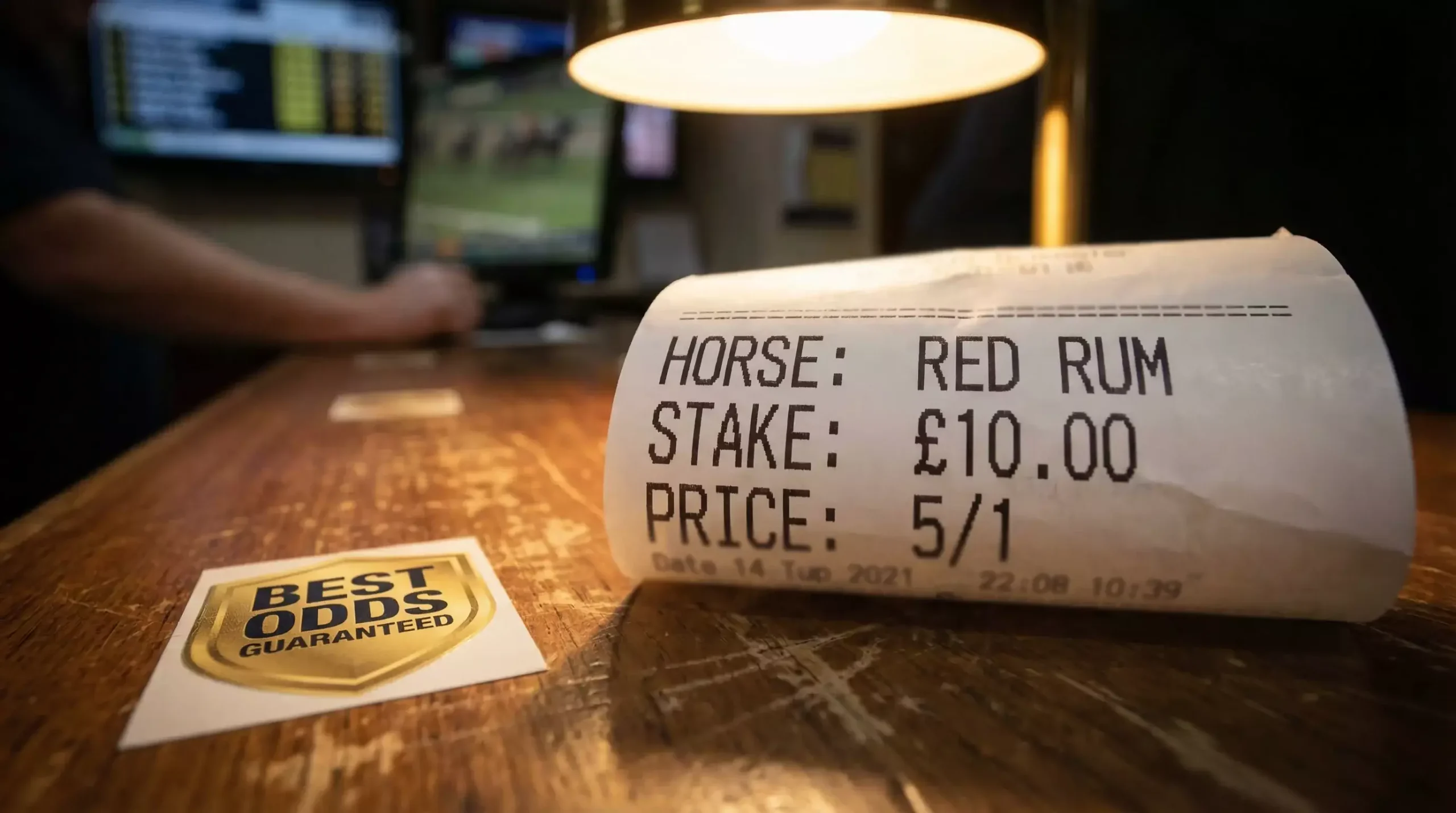
- The Best Deal in Horse Racing — If You Understand It
- How Best Odds Guaranteed Works: The Core Mechanic
- BOG in Action: Worked Examples at Different Prices
- The Fine Print: Restrictions That Limit BOG Value
- BOG vs Taking SP: A Decision Matrix
- Which Bookmakers Offer BOG — and Their Key Differences
- Strategic Use of BOG Within an SP Framework
The Best Deal in Horse Racing — If You Understand It
Best Odds Guaranteed is the closest thing to free insurance in horse racing. Take an early price on a runner, and if the starting price turns out to be higher, the bookmaker pays you at the SP instead. If the SP is lower, you keep the price you took. You pay nothing extra for this protection. It sounds too good to be true — and in its purest form, it very nearly is. Best Odds Guaranteed Explained — More on this topic at horse betting sp.
BOG has become a standard offering among licensed UK bookmakers for horse racing, and most punters are at least vaguely aware of it. Fewer understand the mechanics well enough to use it strategically, and fewer still have read the terms and conditions closely enough to know where the protection ends. The gap between the headline promise and the operational reality is where value is either captured or quietly lost.
This article breaks BOG down to its moving parts. It explains how the mechanic works, what it is worth in practice at different price points, where bookmakers impose restrictions that limit its value, and how to integrate BOG into a broader SP betting approach. The anchor phrase is worth keeping in mind throughout: free insurance — but read the terms. The insurance is real. The terms are where the complexity lives.
What makes BOG unusual among bookmaker promotions is that it is not a loss-leader designed to attract new customers and then quietly removed. It has been a stable feature of the UK racing market for well over a decade, offered by the majority of licensed operators as a competitive necessity. A bookmaker that drops BOG risks losing customers to the half-dozen rivals who still offer it. That dynamic keeps the promotion alive — but it also means bookmakers manage its cost through the fine print, restricting who qualifies, what races are covered, and how much they will actually pay out. Understanding those restrictions is not optional; it is the price of using BOG effectively.
How Best Odds Guaranteed Works: The Core Mechanic
The mechanic is elegant in its simplicity. You place a bet on a horse at a fixed price — say, 5/1 — with a bookmaker that offers Best Odds Guaranteed on that race. The bet is settled as normal at your chosen price of 5/1, unless the official starting price is higher. If the SP comes in at 6/1, the bookmaker automatically adjusts your payout to the better price. Your 5/1 bet becomes a 6/1 bet, with no additional stake required. If the SP comes in at 4/1, nothing changes — you are paid at your original 5/1.
BOG applies to win bets and, with most bookmakers, to the win part of each-way bets. The place element of an each-way bet is typically settled at a fraction of the SP if the BOG kicks in, though this varies by operator and the specific terms in play. Understanding this distinction matters if you are an each-way bettor, because the uplift from BOG on the place portion may be calculated differently from the win portion — and sometimes not applied at all.
The trigger for BOG is the official Industry Starting Price, declared at the moment the race begins. This is the same SP that settles all SP bets across the industry. If the ISP for your horse is higher than the price on your betting slip, BOG is activated. The process is automatic with most bookmakers — you do not need to claim it, opt in, or notify anyone. The adjusted payout appears in your account once the result is confirmed.
Timing is the essential variable. BOG only applies to bets placed before the off at a fixed price. If you take SP — leaving the price open — there is no BOG, because there is no fixed price to compare against. The entire premise depends on having committed to a specific number early enough for the market to have moved. Morning prices, early shows and any fixed price offered before the off are all eligible. A bet placed at 10:00am and a bet placed at 14:59 for a 15:00 race both qualify, provided they were taken at a named price.
One subtle point that catches out some punters: BOG compares your price to the SP, not to any intermediate price movement. If you take 5/1 in the morning, the horse shortens to 3/1 by midday, then drifts back to 11/2 by the off, you are paid at 11/2 (the SP) under BOG. You do not benefit from the intraday low of 3/1 — only from the relationship between your price and the final SP. This means BOG rewards patience and early commitment, but it does not reward market timing within the day. The only comparison that matters is your price versus the off.
BOG in Action: Worked Examples at Different Prices
The value of BOG is not constant. It varies with the price range, the magnitude of the drift, and the probability of that drift occurring. Working through examples at different points on the odds scale illustrates where BOG delivers the most and least benefit.
At short prices, consider a £20 bet taken at 2/1. The horse drifts to SP 5/2. Under BOG, the payout is £70 (£50 profit) instead of £60 (£40 profit) — an extra £10, or a 25% uplift on the profit. If the same horse shortens to SP 6/4, you keep your 2/1 and collect £60 regardless. The uplift from drift at these prices is meaningful in percentage terms because the absolute price movement represents a significant fraction of the original odds. FlatStats data shows that at SP Evens, the market margin is approximately −3.87% ROI — the thinnest margin in the SP spectrum. BOG on top of this narrow margin can, for a skilled bettor, close the gap toward breakeven or beyond, because even modest drift at short prices delivers proportionally large uplift.
At mid-range prices, the dynamics shift. Take a £10 bet at 6/1. The SP comes in at 8/1. BOG pays £90 (£80 profit) instead of £70 (£60 profit) — a £20 improvement. The absolute uplift is larger, but the underlying margin the market extracts at these prices is also larger. A horse drifting from 6/1 to 8/1 represents a significant market reassessment; it happens, but less frequently than a shift from 2/1 to 5/2. When it does happen, BOG captures the full benefit.
At longer prices, BOG becomes theoretically more valuable but practically less reliable. A £5 bet at 20/1 with an SP of 25/1 pays £130 instead of £105 under BOG. But at 20/1, the market’s structural margin is already severe — the SP is likely to be significantly shorter than a fair-value price, and drift at these odds is less common in well-traded markets. When outsiders drift, it is often because money has come for a rival, and the drift signals a weaker chance rather than improved value. BOG captures the drift, but the drift itself may be noise rather than signal.
The pattern across these examples confirms a principle: BOG is most strategically valuable where the market margin is thinnest and drift is most likely to reflect genuine market dynamics rather than signal deterioration. That sweet spot sits roughly between Evens and 6/1 — the same zone identified by the price-range analysis of SP returns.
The Fine Print: Restrictions That Limit BOG Value
Free insurance is only as good as the policy wording, and BOG policies are not all written equally. Every major bookmaker offering Best Odds Guaranteed attaches conditions that narrow the scope of the promotion, and understanding these conditions is essential for any bettor relying on BOG as part of a structured approach.
The most common restriction is a maximum payout cap. Several bookmakers will honour BOG only up to a specified maximum return — say, £25,000 or £50,000. For most recreational bettors, this cap is irrelevant. For anyone placing larger stakes on shorter-priced runners, or backing mid-range selections at significant volume, it can bite. A £500 bet at 6/1 that drifts to an SP of 10/1 should return £5,500 under BOG, but if the bookmaker caps BOG payouts at £5,000, you are short-changed. The cap is rarely advertised prominently; it lives in the terms and conditions.
Some bookmakers restrict BOG to certain race types or times. It is common for BOG to apply only to UK and Irish racing, excluding international fixtures. Others limit the promotion to races shown on certain broadcast platforms, or exclude specific meetings. During busy festival periods — Cheltenham, Royal Ascot, the Grand National meeting — some operators tighten BOG terms, either by reducing the maximum payout, adding minimum odds thresholds or withdrawing the offer entirely on selected races where the bookmaker’s liability exposure is highest.
There are also account-level restrictions that have become more prevalent in recent years. Bookmakers may exclude accounts that have been flagged for consistent profitability, restrict BOG to bets placed through specific channels (app-only, or in-shop only), or require a minimum qualifying bet size. These account-level controls reflect the commercial pressure facing the industry. BHA reporting for Q1 2025 showed that total betting turnover on British racing fell a further 9% year-on-year, with average turnover per race on Core fixtures down 14.4%. As turnover contracts, bookmakers have less margin to fund promotional offers like BOG — and the rational response is to restrict the offer to the customer segments where it functions as a marketing tool rather than a cost centre.
The industry context matters. As Richard Wayman, BHA’s Director of Racing, argued in the 2024 racing report: “I’ve no doubt that these [the decline] are headed by the impact of affordability checks and the extent to which they have resulted in people either stopping betting or placing their bets with unlicensed operators, where such checks don’t take place.” The link to BOG is indirect but real. Affordability checks reduce the active customer base, which reduces turnover, which tightens bookmaker margins, which creates pressure to limit the generosity of promotions like Best Odds Guaranteed. The punter who relied on BOG five years ago as an unconditional benefit may find the offer is now hedged with restrictions that did not exist before. Reading the current terms — not the terms you remember — is a necessary discipline.
A final restriction worth noting: BOG is typically void if the bet is placed using a free bet token, bonus funds or a promotional stake. This matters for bettors who receive regular free-bet offers and assume BOG still applies to those stakes. In most cases, it does not. Check the specific wording of each bookmaker’s BOG terms, and assume nothing is included unless explicitly stated.
BOG vs Taking SP: A Decision Matrix
The choice between taking an early price with BOG and simply betting at SP is one that many punters make instinctively, without evaluating the structural factors that determine which option delivers better long-term value. A decision matrix based on those factors provides a more rational framework.
The first variable is overround. Analysis by On Course Profits estimates the average SP overround at approximately 130% — a 30% margin over fair value. When you take SP, you accept the full weight of that margin. When you take an early price with BOG, you accept the margin embedded in the morning price (which may be higher or lower than the SP) but gain the option to upgrade to the SP if it turns out to be longer. The BOG option partially insulates you from the overround, because it gives you the better of two prices that were both formed in a competitive market at different points in time.
The second variable is market direction. If you expect the horse to shorten — perhaps because it is well-fancied and money is likely to arrive for it — taking the early price with BOG locks in the longer number while the SP protection sits dormant. You have captured value that would have been lost by waiting. If you expect the horse to drift — perhaps because it is a less obvious selection in a race with a strong favourite — taking SP might deliver a longer price, but you bear the risk that the drift is a signal of deteriorating form or track conditions rather than improved value. BOG eliminates the downside of the drift scenario, because you are guaranteed at least your original price.
The third variable is fixture tier. On Premier cards with deep, well-traded markets, the SP is generally a reliable price, and the gap between morning prices and SP tends to be modest. BOG adds value, but the value is incremental. On Core cards with thinner markets, the morning price may be more competitive than the SP, and BOG provides a safety net against the wider overround that tends to characterise thinly traded final markets. Here, the BOG option is more valuable precisely because the SP is less reliable.
The matrix simplifies to this: at short prices on Premier cards, BOG is modestly beneficial and SP is a reasonable alternative. At short prices on Core cards, BOG is clearly preferable. At mid-range prices on any card, BOG is strongly preferable because the optionality value is highest in the zone where prices move most. At long prices, neither BOG nor SP offers a structural edge large enough to overcome the market’s margin, and alternative vehicles like BSP or exchange trading should be considered.
Which Bookmakers Offer BOG — and Their Key Differences
Most major licensed UK bookmakers offer some form of Best Odds Guaranteed on horse racing, but the terms vary enough that choosing the right operator for your betting profile is a meaningful decision. The differences sit in the details: maximum payouts, qualifying race types, eligible bet types and account-level restrictions.
Among the largest operators — Bet365, William Hill, Paddy Power, Betfred, Ladbrokes, Coral, Sky Bet — BOG is broadly available for UK and Irish racing, typically on day-of-race bets placed at a fixed price. The core mechanic is identical across all of them. Where they diverge is in the fine print. Some apply BOG automatically to all qualifying bets; others require an opt-in or restrict it to bets placed via specific platforms (the mobile app, for instance, but not the desktop site). Maximum payout caps differ: one bookmaker’s £50,000 limit might be another’s £10,000. For most bettors, these caps are academic. For anyone placing three-figure stakes regularly, the difference matters.
The consistency and reliability of BOG also varies. Some bookmakers withdraw or amend the promotion on busy racedays — particularly during Cheltenham Festival, Royal Ascot and the Grand National meeting — when their liability exposure is highest. Others maintain the standard terms year-round. If festival racing forms a significant part of your annual betting, check whether your preferred bookmaker’s BOG covers those dates at the usual terms, or whether special conditions apply.
Using licensed, BOG-offering bookmakers also carries a less obvious benefit: it keeps your betting within the regulated market. A BHA survey of over 14,000 respondents in 2023 found that roughly 10% of horse racing bettors had used an unlicensed operator. The appeal is understandable — no account restrictions, no affordability checks, sometimes better headline odds. But the trade-offs are severe: no BOG, no recourse in disputes, no contribution to the sport through the betting levy, and no consumer protections if the operator defaults. BOG is one of the tangible benefits of betting with a regulated bookmaker, and it is not replicated on the black market.
A practical approach is to maintain accounts with three or four BOG-offering bookmakers and compare morning prices across them before placing any bet. The operator with the best early price, combined with the broadest BOG terms, gives you the strongest position: a competitive starting point with full optionality on any upward drift. Concentrating all your betting with a single operator means accepting whatever price that operator offers, which may not be the most competitive on any given race. Diversification across bookmakers is a small operational cost with a measurable return.
Strategic Use of BOG Within an SP Framework
BOG is not a strategy in itself. It is a component — arguably the most valuable one — within a broader SP-aware betting framework. Knowing how to integrate it with the other elements makes the difference between incidental benefit and systematic advantage.
The integration works as follows. Begin with the price-range framework: concentrate your selections in the Evens-to-5/1 zone where the SP market’s structural margin is thinnest. Apply the fixture filter: favour Premier racedays where the SP is derived from deep, competitive markets. Then layer BOG on top: take the best available morning or early-afternoon price, with a bookmaker whose BOG terms are confirmed for the race in question. You are now operating with three overlapping advantages — a narrow market margin, a reliable SP, and an option that captures any further improvement in price between your bet and the off.
The timing of your bet within a BOG framework deserves consideration. There is no inherent advantage to placing BOG bets at the earliest possible moment. Morning prices are often the most generous, because bookmakers open with wider margins and narrow them as the market takes shape. But there is a counter-argument: prices set the evening before or at the crack of dawn may not reflect overnight developments — a change of going, a jockey booking, a notable piece of work on the gallops. Waiting until mid-morning or early afternoon allows you to place your bet with more information while still qualifying for BOG. The trade-off between price generosity and informational completeness is situation-specific, but as a default, prices posted between 10:00 and 12:00 on raceday tend to offer a reasonable balance. See also SP and Exotic Bets.
Finally, keep track of which bookmakers are honouring BOG in practice, not just in theory. Promotions change, terms are updated quietly, and what worked last month may not apply today. A five-minute check of the terms before placing any significant BOG bet is a small investment that prevents the kind of unpleasant surprise that turns free insurance into an empty promise. The deal is genuine — but only when the terms support it.
