
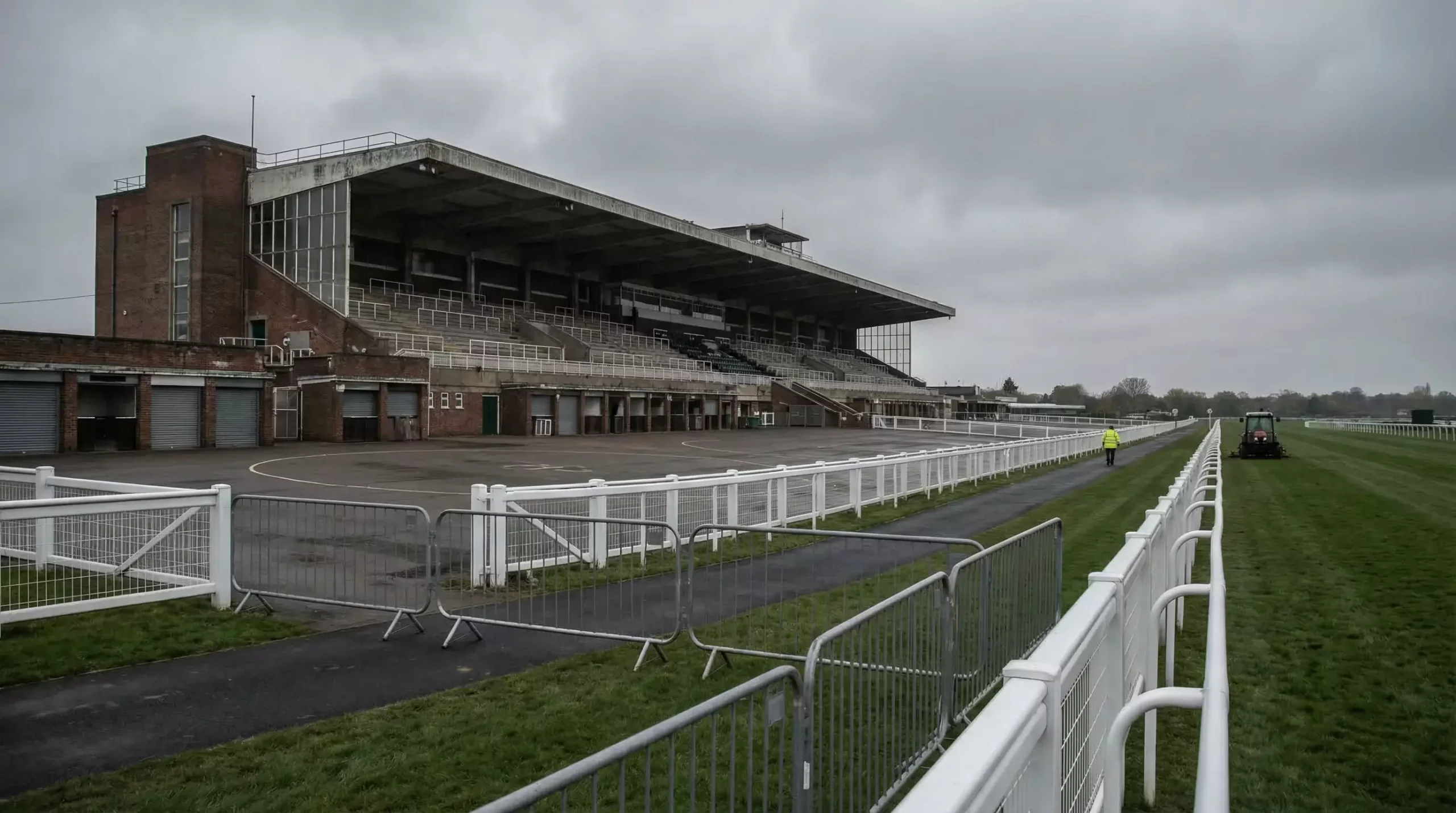
March 2020 — When the Rings Fell Silent
On 17 March 2020, British racing shut down. Cheltenham Festival had just finished — the last hurrah before the country locked its doors. Racecourses went dark. The betting rings, where on-course bookmakers had chalked up prices for more than a century, fell silent overnight.
For the starting price, this was not just an interruption. It was an existential crisis. The traditional SP was built on a sample of prices from those very rings. No crowds, no on-course bookmakers. No on-course bookmakers, no sample. No sample, no starting price — at least not the kind that had governed the settlement of bets in British racing for generations.
Even before the pandemic, the writing was on the wall. On-course betting accounted for just 1.4% of all wagering on British racing at the time of the SPRC’s 2020/21 review. The ring was already a relic of a bygone era in statistical terms; COVID simply removed the pretence that it could sustain a pricing mechanism for an industry that had moved almost entirely online. A pandemic rewrote the rulebook — and the SP that emerged on the other side was fundamentally different from the one that went in.
Timeline: From Lockdown to ISP Launch
The sequence of events moved faster than anyone in the industry expected. What might have taken a decade of committee deliberation was compressed into months by sheer necessity.
March–June 2020. All British racing suspended. No races, no SP. The betting industry pivots to virtual racing, international fixtures, and non-horse sports that resume earlier. The absence of racing exposes how dependent the sport’s funding model is on continuous betting activity.
June 2020. Racing returns behind closed doors. Crowds are banned, but on-course bookmakers are also absent — there is no public to bet with. The SPRC faces an immediate problem: how to calculate an SP without the on-course ring. An interim solution is cobbled together using off-course bookmaker prices, but it is acknowledged as a temporary measure.
Late 2020–2021. The SPRC launches its formal review. The 1.4% on-course figure becomes the anchor of the argument for reform. The Commission consults with bookmakers, the BHA, racecourse operators, and the Horseracing Bettors Forum. The consensus — rare in an industry that agrees on very little — is that the SP must incorporate off-course data as a primary input, not a supplementary one.
2021–2022. The Industry Starting Price is introduced. The ISP uses a blended sample: off-course bookmaker prices form the core, with on-course data included where available. The median calculation is retained, but the pool from which prices are drawn is fundamentally wider. The SPRC sets new parameters for sample size, data-feed quality, and handling of anomalies.
2023 onwards. Crowds return. On-course bookmakers resume trading, though in reduced numbers. The ISP remains the standard, with on-course data feeding into the blended model rather than driving it. The post-COVID SP is a hybrid — and by design, it is permanent.
The Numbers Behind the Shift
The pandemic’s impact on the SP was not just structural — it was financial. Betting turnover on British racing fell 6.8% in 2024 compared with 2023, and a full 16.5% compared with 2022, according to the BHA Racing Report for 2024. Those are not small dips. They represent a market that was contracting before COVID and has continued to contract since, with affordability checks and competition from unlicensed operators adding pressure on top of the pandemic’s legacy.
The good news — and there is some — came from attendance figures. Racecourse attendance in 2025 reached 5.031 million, the first time the five-million mark had been cleared since 2019 and a 4.8% increase on 2024. The crowds came back. But “coming back” to the racecourse and “betting on the course” are not the same thing. The vast majority of those five million spectators placed their bets on phones, not at the ring. The on-course share of total wagering has not recovered to pre-COVID levels, and few in the industry expect it to.
For the SP, the turnover decline means thinner markets. Thinner markets mean fewer data points in the sample. Fewer data points mean a starting price that is, in statistical terms, less robust — more susceptible to being shaped by a small number of large bets or a single bookmaker’s position. The ISP mitigates this by drawing on a wider pool, but it cannot fully compensate for a market that is simply smaller than it used to be.
The Hybrid Model: Where SP Stands Now
The ISP that emerged from the COVID era is not a temporary patch. It is the permanent framework for SP calculation in British racing, and it has brought measurable improvements alongside new questions.
On the positive side, the blended approach has reduced some of the operational weaknesses of the old system. Scheduling reform has also helped: the proportion of Saturday races before 5pm that clashed with simultaneous starts at other tracks dropped from 11.1% in 2022 to just 5.8% in 2024, as reported by the BHA’s analysis. Fewer clashes mean more concentrated betting pools per race, which in turn means more data feeding into each SP calculation. That is a genuine structural improvement.
On the other hand, the ISP introduces its own complexities. Off-course bookmaker prices are shaped by algorithms, risk models, and promotional strategies that do not exist on the racecourse ring. A price offered by an online bookmaker at 12:55pm may reflect the firm’s liability management as much as its view of the horse’s chance. The SPRC must now monitor not just the honesty of the sample but the nature of the prices within it — a qualitatively different challenge from counting heads on a betting ring.
There is also the question of transparency. The old SP, for all its flaws, was visible. You could walk to the ring, read the boards, and see the prices that would form the sample. The ISP is calculated from data feeds that ordinary punters cannot inspect. You trust the process, or you do not. For most bettors, the price on the slip is all they see; the machinery behind it is invisible.
Lessons for SP Bettors
The COVID-era transformation of the SP carries practical implications for anyone who bets at starting price today.
First, the SP you receive in 2026 is a fundamentally different product from the one your father or grandfather backed in 2015. It is derived from a different sample, calculated through a different process, and shaped by a market with different structural characteristics. Any strategy based on historical SP data needs to account for this break in continuity. Patterns observed in SP returns before 2020 may not hold in the post-ISP era.
Second, the quality of the SP now varies more by fixture type than it used to. A Saturday afternoon at Ascot, with full on-course attendance and heavy off-course interest, produces an SP drawn from a deep, liquid market. A Monday evening all-weather fixture at Wolverhampton, with a handful of on-course bookmakers and modest online volume, produces an SP from a much thinner pool. The same methodology is applied, but the raw material is not equivalent.
Third, the shift to ISP has made Best Odds Guaranteed promotions more valuable, not less. Under the old system, the SP was anchored to on-course prices, which sometimes diverged from the prices available online. Under the ISP, the SP is closer to the prices you can actually take with your bookmaker, which means the BOG upgrade — when the SP exceeds your fixed price — is triggered by genuine market movements rather than sampling quirks.
COVID did not kill the starting price. It forced the industry to admit that the old version was already on life support and to build something more resilient in its place. Whether the new version is better for punters depends on how well the SPRC governs it — and how well you adapt your approach to the reality of a market that will never look the way it did before March 2020.