
 Available in US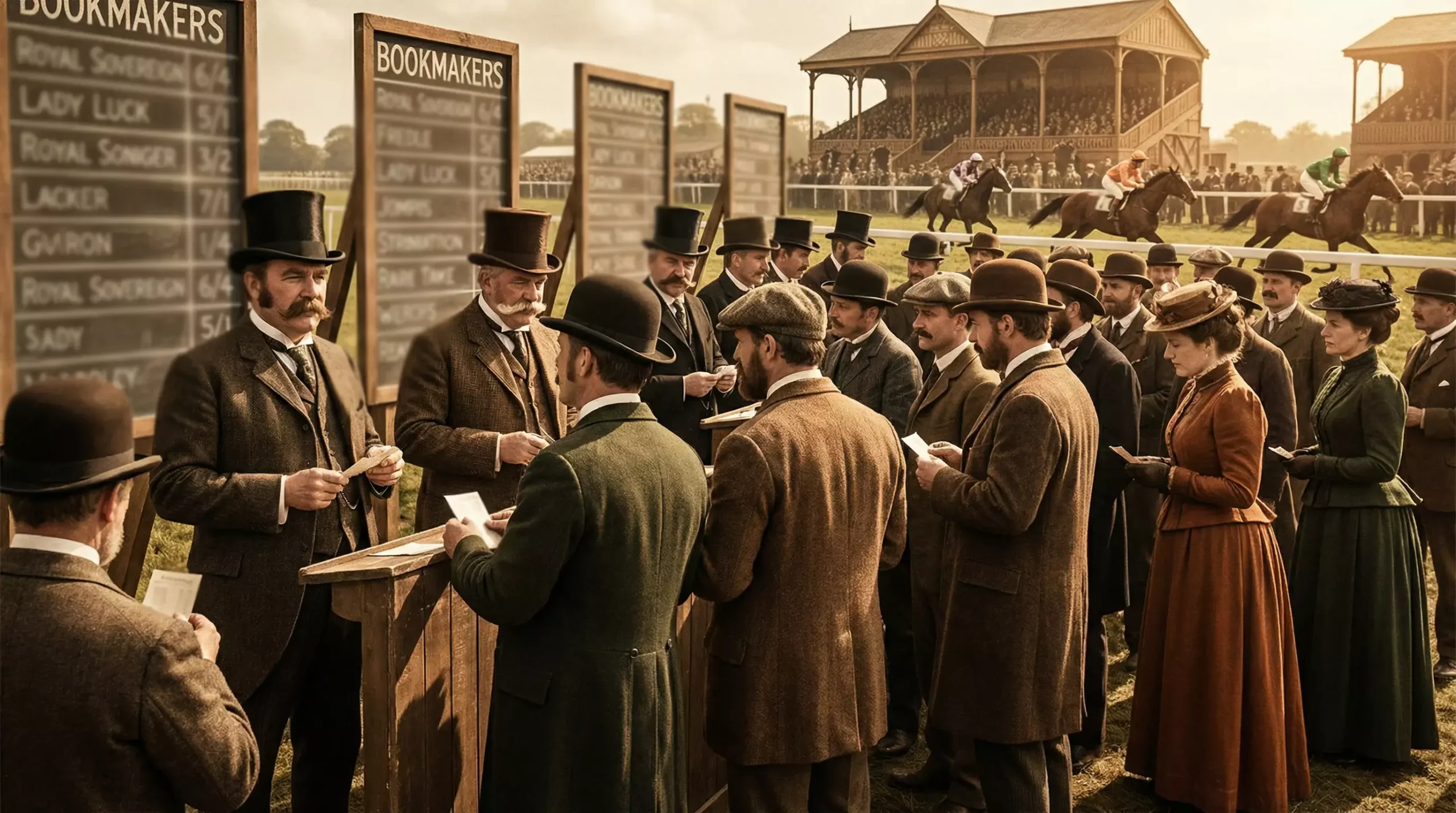
A Price With Two Centuries of History
The starting price is one of the oldest continuously used mechanisms in British sport. Before there were televised odds, before there were betting apps, before there was even a formal regulatory structure for horse racing, there was a price — chalked on a board, agreed between bookmaker and punter, at the moment the race began. Two centuries of settling every race, and the principle has barely changed: the SP is the market’s final word on what a horse is worth. The History of Starting Price — More on this topic at horse betting sp.
The history of that price tracks the history of British gambling itself — from the chaos of the Georgian betting post to the formality of Victorian regulation, through a century of incremental reform, and into the digital upheaval that produced the Industry Starting Price we know today. Some of the regulatory instruments born along the way remain in force: Tattersalls Rule 4, which governs deductions for non-runners, dates to 1886 and is still applied to every SP bet placed in Britain. The roots run deep.
The Georgian and Victorian Origins
Horse racing in eighteenth-century England was a gentlemen’s pursuit funded by private wagers. Matches between two horses, backed by their respective owners, were the standard format. There was no “market” in the modern sense — each bet was a private negotiation, and the concept of a published starting price did not exist.
The shift began in the early nineteenth century as racecourses opened to broader public attendance and professional bookmakers emerged to serve the growing demand. The betting ring — a designated area of the racecourse where bookmakers stood with their boards and offered prices to all comers — became the heart of the market. Prices were chalked, shouted, and adjusted in real time as money flowed in. Tic-tac men relayed price movements across the ring with elaborate hand signals, creating a primitive but effective information network.
By the mid-Victorian era, the need for a standard reference price was becoming urgent. Off-course betting was growing — initially through credit bookmakers and later through street betting that was technically illegal but widely practised. These off-course bets needed a settlement mechanism. The starting price, recorded by representatives of the sporting press at the moment the race began, became that mechanism. It was not a regulatory creation; it was a market convention, born of practical necessity.
The Tattersalls Committee, an industry body that adjudicated betting disputes, formalised many of the rules that governed the SP and its surrounding practices. Rule 4, introduced in 1886, addressed the problem of non-runners distorting the market — a problem that had existed since the earliest days of the ring. The rule’s longevity is testament to the durability of the issues it was designed to solve: horses withdraw, markets shift, and somebody needs to decide how to adjust the payout.
Twentieth-Century Regulation: SPRC and the Modern SP
The twentieth century transformed the SP from a press convention into a regulated institution. The Betting and Gaming Act 1960 legalised off-course cash betting in licensed premises, which created an explosion of high-street bookmaker shops. Suddenly, millions of pounds were being settled at SP every week, and the informal system of press reporters recording prices was no longer adequate.
The Starting Price Regulatory Commission was established to bring governance to the process. Its mandate was narrow but essential: to set the parameters by which the SP was calculated and to monitor the integrity of the result. The SPRC did not — and still does not — set individual prices, overrounds, or margins. Its role, as it has consistently stated via its official position, is to define the methodology and ensure it is followed.
Through the second half of the twentieth century, the SP system matured. The sample of on-course bookmaker prices was formalised, with maximum samples of up to 24 bookmakers at well-attended meetings. The median method — ranking the sampled prices and taking the middle value — was adopted to filter out outliers. Overround per horse became a monitored metric, with the SPRC tracking trends and flagging anomalies.
The system was not without its critics. The 2015 Grand National, with its 39-runner field, produced an overround per horse of 1.67% — not above the three-year average of 1.7%, but the absolute size of the total overround on such a large field prompted public debate about whether the SP was fair to punters. That debate foreshadowed the more fundamental questions that COVID would force a few years later.
The Digital Disruption: Exchanges and BSP
The launch of Betfair in 2000 introduced a fundamentally new form of price discovery to horse racing. The betting exchange allowed punters to bet against each other rather than against a bookmaker, eliminating the overround and replacing it with a flat commission on winnings. The Betfair Starting Price — BSP — was a natural extension: an exchange-generated starting price derived from the balance of supply and demand at the off.
The scale of BSP’s adoption was significant. Betfair’s own analysis of 381,776 races and over 3.2 million runners demonstrated that BSP implied probability tracked actual winning probability with near-perfect accuracy — a degree of efficiency that the traditional SP, burdened by overround, could not match.
BSP did not replace the traditional SP. Licensed bookmakers continued to settle bets at SP, and the SPRC continued to govern the process. But the exchange created a parallel market that exposed the structural costs embedded in bookmaker SP. Punters who could access BSP — particularly at longer prices, where the overround penalty was steepest — had a mathematically superior alternative. The exchange era forced a reckoning: if the SP included a 30% overround while BSP ran at near-zero, how long could the traditional system claim to be the definitive price?
COVID and the Birth of ISP
The answer came not through competitive pressure but through crisis. When British racing shut down in March 2020 and returned behind closed doors, the on-course betting ring — SP’s original home — was empty. The sample from which the traditional SP was drawn had been reduced to zero.
The SPRC’s 2020/21 review laid bare the arithmetic. On-course betting accounted for just 1.4% of all wagering on British racing. The system had been sampling prices from a market that represented a rounding error of total activity. COVID did not create the problem — it removed the ability to pretend the problem did not exist.
The Industry Starting Price was the result. Launched in the early 2020s, the ISP incorporated off-course bookmaker prices as a primary input alongside whatever on-course data was available. The median method was retained, but the pool was fundamentally broader. At well-attended meetings, on-course prices still contributed; at the majority of fixtures, the ISP was driven by off-course data feeds. See also SP and Field Size.
The transition was not without controversy — traditionalists mourned the loss of the ring’s influence, and transparency concerns arose about the opacity of off-course data. But the ISP represented a pragmatic response to a structural reality that the industry could no longer ignore. Two centuries of settling every race had produced a system that needed reinvention — and the reinvention, for all its imperfections, ensured that the starting price survived into a digital age that its Victorian creators could never have imagined.
