
The Percentage That Guarantees the Bookmaker Wins
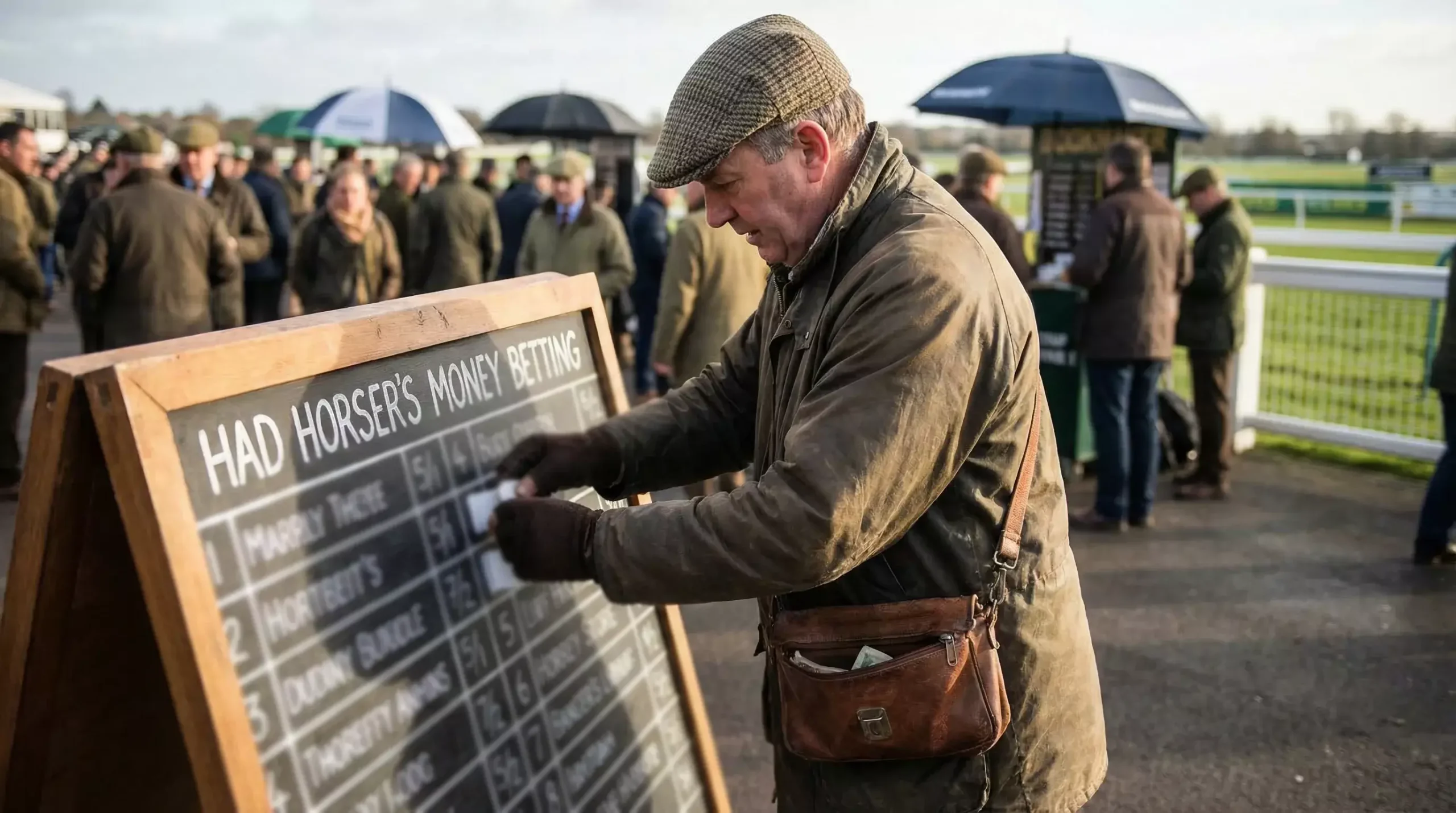
Every starting price contains an invisible tax. It is not listed on your betting slip, not disclosed in the terms and conditions, and not mentioned by the smiling presenter on ITV Racing. But it is there, and it is the single biggest reason that the average SP bettor loses money over time. It is called the overround, and across UK racing, the SP overround averages approximately 130% — meaning the implied probabilities of all runners in a typical race sum to 130% rather than the mathematically fair 100%, as modelled by On Course Profits.
That 30% excess is the bookmaker’s margin, woven into every price in the market. It is not evenly distributed — shorter-priced runners carry proportionally less of the burden than outsiders — but its aggregate effect is consistent: for every £100 wagered across the field at SP, the bookmaker expects to retain roughly £23 before expenses. The invisible tax on every SP bet is the cost of playing the game, and understanding it is the first step toward managing it.
Calculating Overround: A Step-by-Step Walkthrough
The overround is calculated by converting every runner’s SP into an implied probability and then adding them together. If the total exceeds 100%, the excess is the overround.
To convert a fractional price to implied probability, use the formula: Implied Probability = Denominator / (Numerator + Denominator). So a horse at 4/1 has an implied probability of 1 / (4 + 1) = 0.20, or 20%. A horse at Evens (1/1) has an implied probability of 1 / (1 + 1) = 0.50, or 50%. A horse at 1/2 has an implied probability of 2 / (1 + 2) = 0.667, or 66.7%.
Now take a simple five-runner race with the following SPs: 2/1, 3/1, 5/1, 8/1, 10/1. The implied probabilities are: 33.3% + 25.0% + 16.7% + 11.1% + 9.1% = 95.2%. Wait — that is under 100%, which would imply a “fair” book with no margin. In reality, you would almost never see this at SP. A more typical set of prices for the same race might be: 7/4, 5/2, 4/1, 6/1, 8/1, giving: 36.4% + 28.6% + 20.0% + 14.3% + 11.1% = 110.4%. The overround is 10.4%.
In larger fields the numbers climb further. A sixteen-runner handicap with a spread of prices from 5/1 to 33/1 might produce a total implied probability of 135% or more. That 35% overround means the bookmaker has, in expectation, built in a profit margin before a single horse has left the stalls.
The calculation is not difficult, but it requires access to the full set of SPs for a race — something that most betting apps do not display in this format. Dedicated tools and websites perform the calculation automatically, and checking the overround before betting at SP is a habit worth developing. It tells you, at a glance, how much you are paying for the privilege of betting on this particular race.
A lower overround means a more competitive market — more value available to the punter. A higher overround means the bookmaker’s edge is larger and the hurdle for profitable betting is steeper. The number itself does not tell you which horse to back, but it tells you how much room you have for error.
Overround Per Horse: The SPRC’s Key Metric
Total overround is a useful snapshot, but it has a flaw: it rises mechanically with field size. A twenty-runner race will almost always have a higher total overround than a five-runner race, simply because there are more prices contributing to the sum. Comparing the two directly is misleading.
The SPRC addresses this with a metric called Overround Per Horse, or OPH. It divides the total overround by the number of runners, producing a figure that allows meaningful comparison across different field sizes. An OPH of 1.5% in a twenty-runner race and an OPH of 1.5% in a five-runner race indicate equivalent bookmaker margins per runner, even though the total overround in the twenty-runner race is four times higher in absolute terms.
OPH became a point of industry debate when the Horseracing Bettors Forum’s analysis flagged a noticeable rise in OPH during 2023, followed by anomalous fluctuations in 2024 that did not appear to correlate with any obvious external factors. The HBF attributed the 2023 increase to a combination of falling turnover, affordability checks, and changes in cross-sell opportunities for bookmakers — all of which might incentivise bookmakers to widen their margins on individual runners.
For context, the 2015 Grand National — with its field of 39 runners — had an OPH of 1.67%, which the SPRC noted was not above the three-year average of 1.7% despite public concerns about the absolute size of the overround. The total overround on a 39-runner race at 1.67% per horse is over 65%, which sounds shocking until you recognise that it is spread across nearly forty runners. OPH strips away that distortion.
The SPRC itself maintains that it does not set individual prices, overrounds, or margins, nor targets for what they should meet — its role is confined to setting the parameters of the calculation. Whether OPH trends are the responsibility of the Commission or of the market forces that shape bookmaker pricing is one of the most contested questions in SP governance.
How Overround Varies by Race Type and Field Size
Overround is not a fixed number — it shifts meaningfully depending on the characteristics of the race.
Small-field conditions races and Group events tend to have the lowest overrounds. When four to six well-known horses with established form contest a race, the market is efficient: bookmakers have abundant data, the public is well-informed, and competition between firms keeps prices competitive. OPH in these races can drop below 1.5%.
Large-field handicaps sit at the other end of the scale. With sixteen or more runners, many of whom have patchy or hard-to-interpret form, the market is less efficient. Bookmakers build in wider margins to protect against the uncertainty, and the OPH rises accordingly. Saturday handicaps at major tracks — where betting volumes are high — tend to have lower OPH than midweek handicaps at smaller venues, because the liquidity of the market acts as a natural check on margin inflation.
All-weather racing consistently shows higher OPH than turf racing. The combination of smaller samples of on-course bookmakers, lower public interest, and reduced off-course betting volume means the SP is formed in a thinner market. Thinner markets give bookmakers more room to widen their margins without competitive pressure correcting the price.
Festival days — Cheltenham, Royal Ascot, the Grand National meeting — produce some of the tightest overrounds of the year. The sheer weight of money pouring into these races compresses the margin. If there is ever a time when SP offers relatively fair value, it is on the biggest days of the calendar, when every bookmaker is competing for turnover and the market is as liquid as it gets.
Reducing the Overround Drag on Your Bets
You cannot eliminate the overround, but you can make choices that reduce its impact on your long-term returns.
The most direct approach is to bet selectively on races where the overround is lowest. Festival days, well-contested Group races, and high-turnover Saturday handicaps all produce tighter books than midweek all-weather fixtures. If you restrict your SP betting to races where the OPH is below average, you are paying less margin on every bet — a structural advantage that compounds over hundreds of wagers.
Consider using the exchange. Betfair’s BSP operates with near-zero overround because it is a peer-to-peer market rather than a bookmaker-set price. The trade-off is commission on winning bets (typically 2–5%), but for runners at longer prices — where the SP overround is highest — the exchange often delivers a significantly better price. The saving is largest precisely where the overround penalty is most severe.
Best Odds Guaranteed promotions also mitigate overround indirectly. If you take an early fixed price and the SP turns out to be higher, BOG pays the SP. Since early prices are sometimes set before the overround has fully crystallised, you can occasionally lock in a price that is tighter than the eventual SP — while still having the SP as your safety net. It is not a guaranteed reduction in overround, but it tilts the odds in your favour over time.
Finally, understand that the overround is not a conspiracy — it is a business model. Bookmakers need margin to cover operating costs, Levy contributions, and profit. The punter’s job is not to resent the margin but to minimise it. Every percentage point of overround you avoid paying is a percentage point added to your long-term return. The invisible tax on every SP bet is real, but it is not uniform — and the punters who know where the tax is lightest have a quiet, persistent edge.