
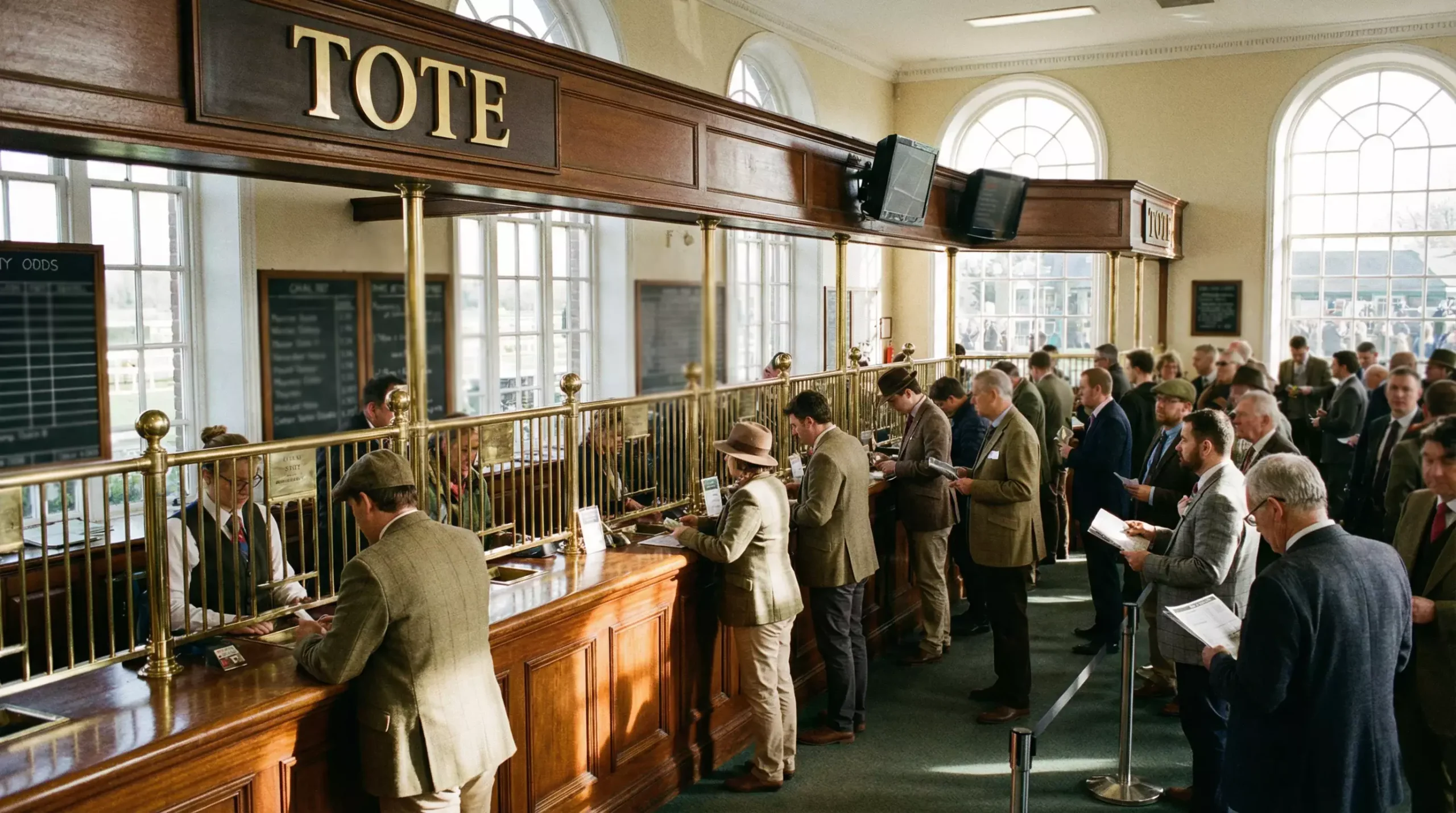
Two Systems, One Racecard
Walk into any British racecourse and you will find two entirely different betting systems operating side by side. On one side, the bookmakers’ boards display fractional prices — the market that produces the SP. On the other, the Tote windows and terminals offer pool betting, where your return depends not on a fixed or starting price but on how much money was wagered by everyone else in the pool. Different pool, different rules — same race.
With racecourse attendance reaching 5.031 million in 2025 — the first time the figure topped five million since 2019 — the Tote remains a major part of the on-course betting experience. It is particularly popular with casual racegoers, festival-day visitors, and punters who enjoy Placepot and other multi-race pool bets. Understanding how Tote dividends compare to bookmaker SP is essential for anyone who bets at the racecourse or uses Tote products online.
How Pool Dividends Are Calculated
The Tote operates on a pari-mutuel basis. All bets on a given pool — the Win pool, the Place pool, the Placepot — are aggregated into a single fund. The Tote deducts its commission (known as the takeout), and the remainder is divided among the winning tickets in proportion to their stake. The dividend per £1 unit is announced after the race.
This is fundamentally different from bookmaker betting. With a bookmaker, the price is set before you bet (or at SP, at the off). Your return is determined by that price. With the Tote, nobody knows the final dividend until the pool is closed and the result is confirmed. The dividend depends on how much money was placed on the winner relative to the total pool.
If a heavily backed favourite wins, the pool is split among many tickets, and the dividend per unit is small — often smaller than the bookmaker SP. If a lightly backed outsider wins, the pool is split among very few tickets, and the dividend can be dramatically larger than the SP. The Tote does not set odds; it distributes money. The result is a payout structure that can diverge significantly from bookmaker prices, sometimes in the punter’s favour and sometimes against.
The Tote’s takeout — the percentage deducted before distribution — is the functional equivalent of the bookmaker’s overround. On the Tote Win pool, the takeout is approximately 19.75% (a net pool of around 80.25%), with higher deductions on exotic bets such as the Exacta and Placepot. For comparison, bookmaker SP overround averages around 30% (on a 130% book). The Tote’s takeout structure does not automatically mean better value — it depends on the distribution of money in the pool — but the mechanics differ from the overround in that the Tote’s deduction is fixed before the race, while the overround varies by market conditions.
SP vs Tote Win: When Dividends Beat the Bookmaker
The relationship between Tote dividends and SP is not fixed. It shifts race by race, depending on pool composition and market dynamics.
When an outsider wins, Tote dividends tend to beat SP. This is because casual and pool-focused bettors concentrate their money on fancied runners, leaving the outsider’s share of the pool very small. The dividend per unit on an outsider can exceed the SP by a substantial margin. If you backed a 20/1 winner at SP, the Tote might pay 25/1 or more, because less pool money was committed to that horse than the bookmaker market implied.
When a favourite wins, the opposite often applies. The pool is dominated by money on the favourite, and the dividend per unit is diluted. The Tote might pay 6/4 on a horse that returned 2/1 at SP. The bookmaker’s overround — averaging approximately 130% as modelled by On Course Profits — is partially offset by the Tote’s lower takeout, but the concentration of pool money on the favourite pushes the dividend below SP.
The implication is clear: Tote Win betting tends to offer better value on outsiders and worse value on favourites compared with SP. Punters who specialise in longer-priced selections — particularly in competitive handicaps where the pool is spread across many runners — may find the Tote a structurally better proposition than SP over time. Punters who focus on short-priced runners are almost always better off with SP or a fixed price.
Tote Placepot and SP Each-Way: A Comparison
The Placepot is the Tote’s flagship multi-race product. It requires you to select a horse to place in each of the first six races at a meeting. All stakes go into a single pool, and winning tickets share the fund after deductions. The Placepot has no direct equivalent in bookmaker betting — it is a unique pool product that operates on entirely different mechanics from an SP each-way accumulator.
With an SP each-way accumulator, your return is determined by the SP of each selection and the place terms applicable to each race. You know the structure in advance: each leg settles at a fraction of the SP, and the returns compound across legs. The overround applies at each stage, and the cumulative effect over six legs can be substantial.
With the Placepot, none of these calculations apply. Your return depends solely on the total pool size, the number of winning tickets, and the Tote’s takeout. A Placepot can pay £5 if every favourite places, or £5,000 if two or three outsiders hit the frame and thin out the surviving tickets. The variance is enormous, and the expected value is almost impossible to calculate in advance.
For festival days, the Placepot pools can be very large — sometimes exceeding £1 million — which creates a deeper, more stable dividend. For midweek meetings, the pools are thin, and dividends can be erratic. The comparison with SP each-way betting is not about which is “better” in a general sense; it is about which structure suits your betting style and risk tolerance. SP each-way offers predictable mechanics and compounding returns. The Placepot offers high variance and the possibility of outsized payouts from small stakes.
Choosing Between Tote and SP: A Practical Guide
The choice between Tote and SP is not either/or — many experienced punters use both, depending on the situation.
Use the Tote Win pool when you are backing outsiders at well-attended meetings where the pool is large enough to produce stable dividends. The Tote’s structural advantage over SP is greatest on longer-priced runners, and large pools reduce the risk of erratic dividends.
Use SP (or a fixed price) when you are backing favourites or short-priced runners. The bookmaker market is more competitive at the short end of the price spectrum, and Best Odds Guaranteed promotions add further value that the Tote cannot match.
Use the Placepot when you want multi-race exposure from a small stake and are comfortable with high variance. The Placepot is essentially a lottery-style product with a skill element — the skill lies in selecting placers rather than winners, which shifts the focus toward consistency and track form rather than finding a single winner at a big price.
Avoid the Tote on thin-pool days unless you are specifically chasing a volatile dividend. Midweek all-weather meetings produce small pools where a single large bet can distort the dividend structure. SP on these cards, while imperfect, is derived from a broader market and is less susceptible to single-bet distortion.
Two systems, one racecard. Neither is universally superior. The punter who understands both — and knows when each earns its place — has an edge over the one who defaults to the same approach every time.