
The Mechanics Most Punters Never See
Every race in Britain settles thousands of bets at a single number: the starting price. It appears on betting slips, flashes across screens in the final seconds before the off, and determines payouts for anyone who chose not to lock in a fixed price. Yet for a figure that carries such weight, remarkably few punters understand how it actually comes into being. The maths behind the market is both more methodical and more surprising than most assume.
For the better part of a century, the starting price was forged in the betting ring — that tight cluster of on-course bookmakers who chalk up their boards, adjust odds in real time, and compete for custom as the horses circle the parade ring. An official sample of those board prices was taken just before the off, and from that sample a single representative price was declared for each runner. The system worked well enough when the ring was the beating heart of horse racing’s economy. But the world shifted. Online betting boomed, high-street shops expanded their reach, and the on-course market quietly shrank to a fraction of its former self. By the time the Starting Price Regulatory Commission reviewed the situation in 2020/21, on-course wagers accounted for just 1.4% of all bets placed on British racing. A price derived almost entirely from the ring was, in effect, being shaped by a market that represented barely one punter in seventy.
That realisation triggered the most significant overhaul of starting price methodology in modern racing history — the shift to the Industry Starting Price, or ISP. Understanding how SP is calculated today means understanding both the traditional on-course method that still underpins it and the off-course data layer that was grafted on to keep the process relevant. This article walks through every step, from the officials recording prices in the ring to the algorithm that blends those figures with off-course odds. Whether you bet at SP regularly or simply want to know what happens to your money when you leave the price open, this is the machinery you need to see.
The On-Course Sample: Who Sets the Prices
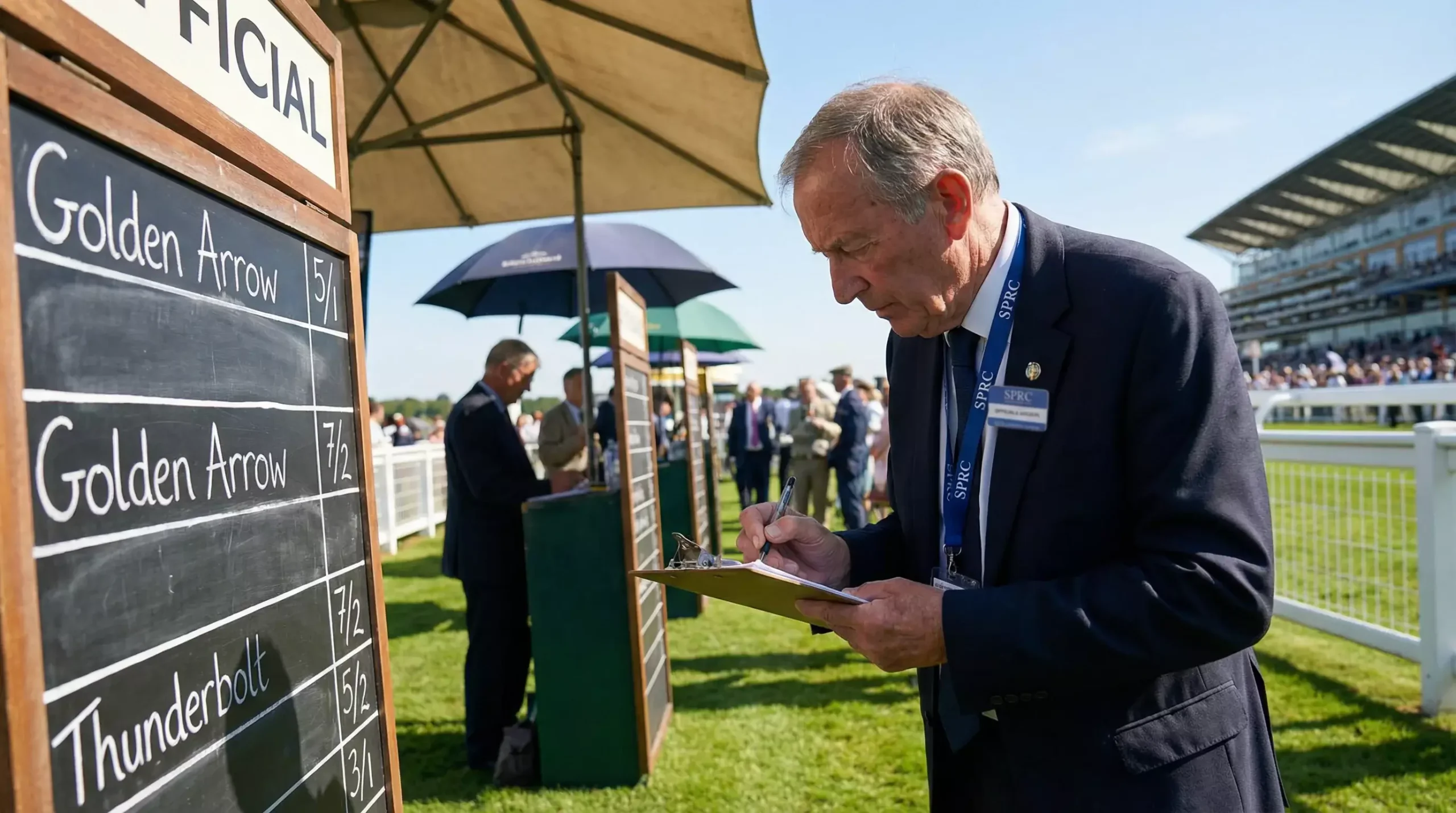
Before any calculation begins, someone has to record the raw material. At every British race meeting, a team of SPRC-appointed officials — known as SP reporters — takes their position in or near the betting ring. Their job is to observe the prices displayed by on-course bookmakers in the minutes leading up to the off and compile a representative sample of the market. It sounds straightforward. In practice, it is a nuanced exercise in timing, selection and judgement.
The reporters do not simply write down the first numbers they see. They wait until the market has settled — or is as close to settled as it will get — in the final moments before the race begins. On-course bookmakers adjust their boards constantly: a rush of money for one horse forces that price down, which in turn pushes rival prices up. The SP reporters are looking for the prices that reflect genuine equilibrium, not a mid-adjustment snapshot that will shift within seconds.
The sample itself has defined boundaries. According to the SPRC’s consultation document, the maximum number of bookmakers included in the sample is 24, and the minimum is six. On quieter fixtures — particularly winter all-weather meetings where the ring is sparsely populated — that minimum can drop as low as three. The size of the sample matters enormously: a median drawn from 20 bookmakers is far more robust than one drawn from four. All-weather meetings on a cold Tuesday in January, where three or four bookmakers might be trading modest books, inevitably produce an SP that is more vulnerable to individual pricing quirks. Big-field handicaps at Cheltenham or Royal Ascot, with a full complement of ring bookmakers competing hard for business, give the SP reporters a rich, competitive dataset to work with.
Each bookmaker in the sample has their board price recorded for every runner in the race. If a bookmaker is not quoting a price for a particular horse — usually an outsider they have little interest in laying — that gap is dealt with through the ranking process. The key point is that the sample must include bookmakers who are actively trading, not simply standing in the ring with a blank board or an unchanged tissue price from the morning.
It is worth pausing on what the sample is not. It is not a poll of opinion. The reporters are not asking bookmakers what they think a horse should be priced at; they are recording the prices that bookmakers are willing to lay to real punters, with real money at stake. That distinction matters because it grounds the SP in actual market forces rather than theoretical assessments. A bookmaker who prices a horse at 5/1 on the board is offering to pay out at 5/1 — and that commitment is what gives the sampled price its legitimacy.
The reporters compile the full set of prices for each runner and pass the data forward for the next stage. At this point, the raw material is a grid: rows of horses, columns of bookmakers, and a price in every cell. Turning that grid into a single starting price for each runner is where the real work begins.
Ranking, Splitting and Finding the Median
With the sample collected, the process shifts from observation to calculation. The goal is to distil each runner’s range of quoted prices into a single, representative figure. The method is built around the median — not the mean, and the distinction is important.
For each horse, the sampled prices are lined up in order from shortest to longest. If the sample contains 12 bookmakers, you get 12 prices arranged from the lowest odds to the highest. The median is the middle value. With an even number of prices, the median sits between the two central figures, and specific rounding conventions apply. With an odd number, it is simply the middle price. The reason for using a median rather than an average is that it resists distortion from outliers. If eleven bookmakers price a horse at around 4/1 and one rogue operator has it at 12/1, a mean would drag the figure upward; the median would shrug it off.
The process also involves splitting, which handles a subtlety that casual observers often miss. Bookmakers do not always quote prices on a uniform grid. One might show 7/2, another 4/1, and a third 100/30. These are not identical prices, but they sit close together on the odds spectrum. The SPRC rules define which prices can be treated as equivalent and where a split is required. When the two central prices in an even-numbered sample are adjacent recognised odds — say 3/1 and 100/30 — the SP is returned as the lower of the two. When they straddle a wider gap, a split price may be declared: you might see 7/2 returned as the SP when the central values are 3/1 and 4/1.
Split prices are one of the features that occasionally surprise punters who expect the SP to match a price they actually saw on a bookmaker’s board. The SP does not have to correspond to any single board price; it is a statistical output that represents the centre of the market. A returned SP of 100/30 might not have appeared on any board at all, yet it accurately represents the midpoint between the prices that were displayed.
The ranking process also deals with absentees — horses that some bookmakers chose not to price. If a bookmaker in the sample did not display a price for a runner, that absence is excluded from the ranking rather than treated as a zero or an infinity. The median is then drawn from the prices that were actually offered. In practice, this mainly affects outsiders in large-field handicaps, where a bookmaker might quote only the top ten in the betting and leave the 33/1 shots unlisted. The SP for those outsiders is derived from whatever subset of the sample did bother to quote them.
At the end of this process, every runner in the race has a single price. That price is the traditional on-course SP — the figure that, until recently, was the final word. It still plays a role, but it now feeds into a broader calculation. Before the ISP era, though, this was the finish line: the median was the starting price, published instantly, and every SP bet in the country settled at that number.
From On-Course SP to Industry Starting Price
That on-course median served as the official SP for the better part of a century. The ring was where the money was, and a price derived from that ring was a credible representation of the market. Then the market moved. Online operators grew to dominate betting turnover. High-street shops handled volume that dwarfed anything happening trackside. And the on-course ring, though rich in tradition, became a progressively thinner slice of the overall pie. When the SPRC’s 2020/21 review confirmed that on-course betting accounted for only 1.4% of total wagering on British racing, the case for reform became unanswerable. A price based almost entirely on a market fragment serving fewer than two in every hundred punters could not credibly claim to represent the wider betting landscape.
The response was the Industry Starting Price — ISP for short. Introduced in stages following consultation, the ISP does not abandon the on-course sample; it supplements it. The model takes the traditional on-course median and blends it with off-course price data, drawn from the odds displayed by major online and retail bookmakers at the time of the off. The idea is to anchor the SP in the market that actually exists rather than the market that used to exist.
The SPRC’s official position on its role in this process is carefully worded. As stated on the commission’s website: “The SPRC does not set individual prices, overrounds or margins, nor does it set targets for what they should meet. Its responsibility is simply and straightforwardly to set the parameters by which the SP is calculated.” In other words, the SPRC defines the rules — the sample size, the blending formula, the rounding conventions — and then lets the data produce the answer. It is a regulatory framework, not a pricing committee.
The blending mechanism itself introduces a weighted relationship between on-course and off-course prices. The exact weighting is not published in full detail, but the principle is transparent: when the on-course sample is large and competitive, it carries more weight; when the ring is thin and the off-course market more liquid, the balance shifts. This means the ISP on a busy Saturday afternoon at Newmarket — with 20 bookmakers in the ring and a strong off-course market — looks different in construction from the ISP on a Monday evening at Wolverhampton, where three on-course layers might be trading alongside a much more active online market.
One consequence of this shift is that the SP has become more resistant to manipulation by a small number of on-course bookmakers. In the old model, a concerted effort by a handful of ring bookmakers to inflate or suppress a price could move the SP noticeably. Under the ISP model, the same manipulation would need to extend across the off-course market as well — a far harder proposition when the off-course operators are pricing to millions of pounds of liability rather than hundreds.
The transition was not without controversy. Some on-course bookmakers argued that the ISP diluted the role of the ring and, by extension, reduced the incentive for them to attend meetings at all. The counter-argument, accepted by the SPRC, was that a starting price must reflect the market it serves. When 98.6% of bets are placed off-course, insisting that only on-course prices matter is not tradition — it is inertia.
For punters, the practical effect is subtle but measurable. The ISP tends to produce slightly tighter prices on favourites and slightly wider prices on outsiders compared with the old on-course SP, because the off-course market generally carries less overround at the top of the market and more at the bottom. Whether that helps or hurts depends entirely on where in the betting your interests lie — a theme that runs through every strategic decision around SP.
Overround Per Horse: The Hidden Metric
Most punters are familiar with the concept of overround — the margin built into a book that ensures the bookmaker comes out ahead in the long run. If you add up the implied probabilities of every runner in a race, the total will exceed 100%. That excess is the overround, and it represents the theoretical edge the market has over the bettor. What is less widely understood is how that overround distributes across individual runners, and that distribution is where the story gets interesting for SP bettors.
Overround per horse (OPH) isolates the margin applied to a single runner’s price. In a race with ten runners and a total overround of 130%, the overround per horse is roughly 3% — though the actual distribution is not uniform. Shorter-priced horses tend to carry less overround per runner than longshots, because bookmakers face greater liability on favourites and price them more competitively to manage risk. Outsiders, by contrast, attract smaller stakes and can be priced with a wider margin. This asymmetry is one of the engines behind the favourite-longshot bias that has been documented in racing markets for decades.
The OPH metric also serves as a barometer of market health. The SPRC monitors OPH trends across the fixture calendar, and the data from recent years tells a story of gradual tightening that suddenly reversed. According to analysis published by the Horseracing Bettors Forum using Proform software data, OPH rose noticeably in 2023 after a period of relative stability. Several factors converged: falling betting turnover driven by affordability checks reduced competitive pressure in the ring, changes to media rights altered the commercial incentives for bookmakers attending meetings, and the contraction of cross-selling opportunities gave operators less reason to accept thin margins on racing. In 2024, the picture became even more complex, with anomalous OPH fluctuations that did not correlate neatly with any single external cause.
Why should a punter care about OPH? Because it directly determines the value embedded in — or extracted from — every SP bet. An OPH of 2% means that the SP for a given horse is roughly 2% shorter than a perfectly fair price. An OPH of 5% means you are accepting a more significant built-in disadvantage. When OPH rises across the board, the SP becomes a worse deal for the bettor at every price point, even if the headline overround on the full book appears stable. That happens because total overround can be distributed in ways that hit outsiders harder while leaving favourites’ prices relatively intact — which is exactly what tends to happen when turnover falls and bookmakers focus their risk management on the most popular runners.
Tracking OPH over time gives bettors a structural advantage: it tells you whether the SP market is getting tighter or looser, and at which price ranges the squeeze is most acute. It is not the kind of metric that will help you pick a winner, but it is precisely the kind that determines whether your winners pay enough.
Worked Example: A Real Race Calculated
Theory is useful; a concrete example is better. Let’s walk through a simplified but realistic SP calculation to see the machinery in action.
Imagine a six-runner race at a midweek meeting. Eight on-course bookmakers are active in the ring. For the favourite — let’s call it Horse A — the eight bookmakers display the following prices just before the off: 5/2, 5/2, 11/4, 11/4, 3/1, 5/2, 11/4, 5/2. The first step is to rank these from shortest to longest: 5/2, 5/2, 5/2, 5/2, 11/4, 11/4, 11/4, 3/1. With eight prices, the median sits between the fourth and fifth values — 5/2 and 11/4. These are adjacent recognised odds, and under SPRC rules the lower figure is returned. Horse A’s on-course SP: 5/2.
Now consider Horse F, a 20/1 outsider. Only five of the eight bookmakers bothered to price it: 16/1, 20/1, 20/1, 25/1, 25/1. Three bookmakers left it off their boards entirely. Those absences are excluded. The median of five prices is the third value: 20/1. Horse F’s on-course SP: 20/1.
Under the ISP model, these on-course figures are then cross-referenced against off-course prices. Suppose the major online bookmakers are showing Horse A at 5/2 and 11/4, tightly clustered around the on-course figure. The blending confirms 5/2 — the two markets are in agreement. But imagine Horse F is showing at 16/1 with several online operators while the on-course market has it at 20/1. The ISP algorithm would pull the final SP for Horse F closer to the off-course consensus, perhaps settling at 16/1 or 18/1 depending on the relative weightings. The thinness of the on-course sample (only five bookmakers pricing this horse) means the off-course data gets more say.
Now look at the overround. If this six-runner race returns an SP book totalling 126%, the overround is 26%, and the OPH is approximately 4.3%. For context, the SPRC’s data from larger events tells a different story. Analysis of the 2015 Grand National, with its field of 39 runners, found an OPH of just 1.67% — not out of line with the three-year average of 1.7% for comparable races. In a race with nearly forty runners, each horse carries a tiny fraction of the total overround. In a six-runner sprint, each horse’s share is far larger, and the built-in margin against the SP bettor is correspondingly heavier.
That is why field size matters as much as the headline odds. Backing a 5/2 favourite in a six-runner race at SP is a structurally different proposition from backing a 5/2 favourite in a 20-runner handicap, even if the price looks identical. The overround each horse absorbs is radically different, and the SP in the smaller field will, on average, be a less generous representation of the true probability. Anyone who bets at SP without considering this is leaving money on the table — not on any single race, but consistently, across thousands of bets.
Why Calculation Method Matters for Your Returns
It is tempting to treat the starting price as a given — a background number that simply appears and does its job. But as every section of this article should have made clear, the SP is not a given. It is a constructed figure, shaped by sample sizes, median calculations, blending algorithms and the competitive dynamics of two distinct markets. Understanding how it is constructed is not an academic exercise; it is a practical one, because the method determines the value you receive.
Consider three implications. First, the size of the on-course sample matters for the reliability of the SP. At a well-attended Saturday meeting, the median is drawn from a large, competitive sample, and the SP is likely to sit close to a fair market price. At a poorly attended all-weather fixture, the sample shrinks and the SP becomes more susceptible to the pricing choices of a few individuals. If you habitually bet at SP on quiet meetings without recognising this, you are accepting a structurally less reliable price.
Second, the ISP’s integration of off-course data helps, but it is not a cure-all. Off-course bookmakers have their own margins, their own models, and their own incentives to shade prices in ways that favour their bottom line. The ISP blends two imperfect datasets to produce a more robust result, but it does not eliminate overround — it redistributes it. The SP is still a price that is set, in part, to protect the bookmaker’s position. No blending formula changes that fundamental dynamic.
Third, the overround distribution across a race — measured by OPH — tells you where the margin is being extracted. In races with small fields, each horse bears a large share of the overround, and SP bets carry a heavier cost. In large-field races, the overround is spread more thinly, and the SP is a comparatively better deal. Punters who bet at SP without considering field size are making an unconscious choice to accept whatever margin the market imposes, regardless of whether that margin is 1.5% or 5%.
None of this means SP is a bad bet. For many punters, taking the starting price is a rational decision — particularly when combined with Best Odds Guaranteed promotions or when the market is too volatile to justify locking in an early price. But it is a better decision when you understand what goes into the number. The maths behind the market is not hidden. It is simply not advertised. Now that you have seen it, the question is what you do with the knowledge.